With the rapid rise in air source heat pump installations across the UK and in particular, London, one question continues to surface: are air source heat pumps noisy? While many homeowners worry about disturbing their neighbours or breaching planning conditions, the reality is often misunderstood.
Modern heat pumps are designed with noise reduction in mind, and most operate at levels similar to a quiet conversation, typically between 40 and 55 dB(A) at one metre. However, their performance depends heavily on factors such as placement, surrounding surfaces, and local background noise levels.
In this article, we explore seven proven facts about heat pump noise. By cutting through common myths, explaining how noise is measured, and outlining what UK regulations actually say about your ASHP installation.
This guide has been prepared by professional acoustic consultants at Polaris Acoustics, specialists in environmental noise and planning compliance.
Fact 1 – Modern Heat Pumps Are Quieter Than You Think

It’s a common misconception that air source heat pumps are loud, whirring machines that hum constantly in the background. In reality, most modern units are engineered for quiet performance, with noise levels that are often lower than everyday household sounds.
Typical sound pressure levels for today’s models typically range between 40 and 60 dB(A) at one metre. To put that into context:
- A quiet conversation measures around 55 dB(A)
- A standard refrigerator operates at roughly 40 dB(A)
- A dishwasher in eco mode might reach 50 dB(A)
This means that under normal conditions, a well-installed heat pump produces a gentle broadband sound, comparable to soft airflow, or gentle white-noise, rather than a distinct mechanical buzz or hum.
It’s also important to understand the difference between sound power level and sound pressure level — two terms often confused in marketing literature.
- Sound power level (Lw) is the total acoustic energy emitted by the unit itself. This is akin to the power output of a light-bulb and is a constant.
- Sound pressure level (Lp) is what you actually hear at a given distance, influenced by factors like reflection, distance, and barriers. Similar to light, how the amount of lumens at a distance reduces from the light source.
Manufacturers typically quote the higher sound power level figure or a sound pressure level measured at 1 metre, but the sound pressure level at a neighbour’s boundary, which determines compliance with planning guidance, is usually much lower. For example, a 55 dB(A) sound power rating might translate to only 38–42 dB(A) at a property boundary, depending on distance and surroundings.
Independent testing under MCS 020 ensures that published data is measured under consistent, real-world conditions. Many newer models, such as the Mitsubishi Ecodan Ultra Quiet and Vaillant aroTHERM Plus, are designed to effortlessly meet these standards.
In short, when correctly specified and positioned, an air source heat pump is no noisier than an extract fan for your bathroom or shower. A far cry from the myths that still circulate online about constant droning or disruptive humming.
Fact 2 – Location and Installation Matter Most

Even the quietest air source heat pump can sound intrusive if it’s installed in the wrong place. Location and mounting methods have a major impact on how sound propagates and how noticeable it becomes at nearby properties, including the property where the plant was installed.
A heat pump’s acoustic footprint depends on several key factors:
- Distance to boundaries or windows – the closer the unit is to a neighbour’s garden or bedroom window, the more likely the sound will be perceived.
- Reflections and façades – hard surfaces such as brick walls, fences, or corner courtyards can reflect and amplify sound, sometimes adding several decibels.
- Mounting type – wall brackets can transfer vibration through masonry, whereas ground-mounted systems with anti-vibration pads usually perform better.
- Background noise context – in rural or suburban areas, the natural ambient noise at night can be as low as 25–30 dB(A), meaning any tonal hum stands out more clearly than in a city environment.
When sound propagates through open air, it follows the inverse square law, roughly a 6 dB reduction for each doubling of distance. The table below illustrates this simple but important concept:
| Distance from Source | Approximate Sound Reduction | Example (from 55 dB(A) at 1 m) |
|---|---|---|
| 1 metre | Reference level | 55 dB(A) |
| 2 metres | −6 dB | 49 dB(A) |
| 4 metres | −12 dB | 43 dB(A) |
| 8 metres | −18 dB | 37 dB(A) |
Of course, real-world results vary depending on reflections, ground absorption, and barriers — but this principle highlights why even a small change in position can make a big acoustic difference.
Careful siting also helps maintain compliance with MCS 020 and local planning guidance, both of which assess sound levels at the nearest noise-sensitive receptor (usually a neighbour’s façade). Positioning the outdoor unit away from direct lines of sight or using the building itself as a natural barrier can reduce perceived noise by several decibels without any additional hardware.
In essence, good acoustic design starts with good placement. By considering the unit’s sound propagation path and surrounding environment, most noise issues can be prevented long before they ever arise.
Fact 3 – Neighbour Disturbance Depends on Context

Whether or not a heat pump is considered “noisy” often comes down to its context — specifically, how its sound compares with the surrounding environment and who might be affected. In environmental acoustics, these people or buildings are referred to as “noise-sensitive receptors”. This term covers places where quiet conditions are normally expected, such as homes, gardens, schools, or care facilities.
To objectively determine if a noise source is likely to cause disturbance, acoustic consultants use BS 4142:2014+A1:2019 — the British Standard for assessing sound from industrial and commercial sources, including air source heat pumps. Under this method, the rating level (which represents the total sound from the unit) is compared with the background sound level of the area.
If the rating level exceeds the background by more than a few decibels, the standard predicts the likelihood of complaints:
| Difference (Rating – Background) | Typical Interpretation (BS 4142) |
|---|---|
| +0 dB or below | Unlikely to cause disturbance |
| +3 dB | Low likelihood |
| +5 dB | Likely adverse impact |
| +10 dB or more | Significant adverse impact |
A well-sited and modern heat pump typically achieves a rating level no more than +3 dB above background, meaning it’s unlikely to result in complaints when installed correctly.
BS 4142 also includes penalties for acoustic features that make a sound more noticeable — such as tonality (a clear hum or whine), impulsivity, or intermittency. These penalties (ranging from +2 to +9 dB) are added to the measured sound level to ensure that any distinctive characteristics are fairly represented.
In cases where a neighbour does raise a concern, local authorities usually investigate under the Environmental Protection Act 1990. However, if a system meets MCS 020 limits and follows good acoustic practice, enforcement action is very rare.
For property developers or homeowners seeking peace of mind, a Plant Noise Assessment to BS 4142 can confirm compliance and demonstrate that a heat pump will operate well within accepted limits — avoiding costly disputes or planning delays.
In short, the question of ‘are air source heat pumps noisy’, is not just how loud a heat pump is, but how it relates to its environment that matters most.
Fact 4 – UK Regulations Keep Noise Within Safe Limits

Concerns about noise from air source heat pumps are not left to guesswork — they’re governed by clear, measurable limits set out in UK guidance. The most relevant benchmark is MCS 020, the standard used to determine whether an installation qualifies as Permitted Development under national planning rules.
Under MCS 020, the outdoor unit must not generate a noise level exceeding 42 dB(A) when measured at the nearest neighbouring façade. This limit is designed to ensure that typical domestic heat pumps operate quietly enough to protect residential amenity, even in low-background environments.
To comply, installers must calculate the predicted sound pressure level at the closest “noise-sensitive receptor” — usually the nearest window of a neighbouring dwelling — and consider both distance attenuation and directivity (the way sound spreads). If the predicted level stays at or below 42 dB(A), the system can generally proceed without the need for formal planning permission.
However, there are situations where a planning application is still required, such as:
- Multiple outdoor units being installed at the same property.
- Locations within conservation areas or listed buildings.
- Sites with unusually close boundaries or complex topography.
- When local authorities impose stricter planning conditions or require a Noise Impact Assessment as part of the application.
A frequent point of confusion lies in the difference between a manufacturer’s sound power rating and the sound pressure level used for compliance. The sound power rating is a fixed laboratory value representing total emitted energy (often 55–65 dB(A)), whereas the sound pressure level is what’s actually experienced at a specific location — typically 10–20 dB lower, depending on distance and screening.
Because these calculations depend on real-world conditions, many councils request supporting evidence in the form of a Noise Impact Assessment for Planning. This demonstrates that the predicted levels meet MCS 020 and BS 4142 requirements, helping avoid enforcement issues later on.
Ultimately, UK regulations already provide a robust safeguard: if an air source heat pump meets MCS 020 or planning noise conditions, it is — by definition — quiet enough to protect neighbouring amenity.
Fact 5 – Technology Has Evolved for Quiet Operation
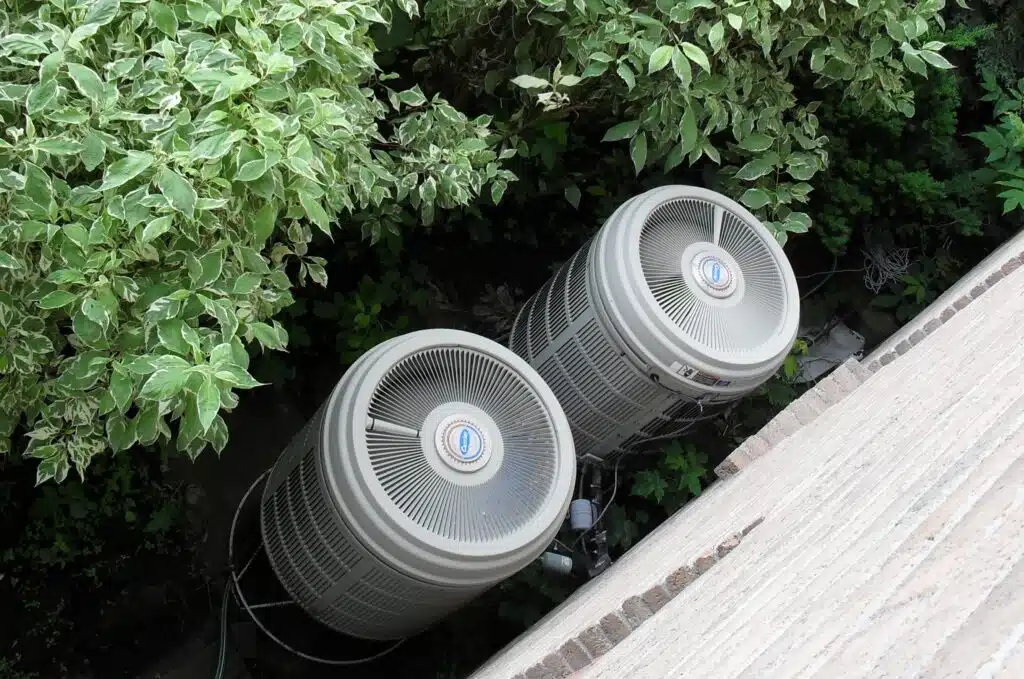
Just as car engines and refrigerators have become quieter over the years, so too have heat pumps. Advances in engineering and control technology have led to a new generation of low-noise heating systems designed specifically for residential comfort.
Modern inverter-driven compressors are the biggest game-changer. Unlike older on/off systems, these continuously vary their speed to match heating demand. That means they rarely run at full power, significantly reducing noise during everyday operation. Likewise, variable-speed fans can ramp down when outdoor temperatures are mild, producing only a soft airflow instead of a constant mechanical hum.
Many of these next-generation ASHPs now feature dedicated “Quiet Mode” settings that automatically lower fan and compressor speeds during night-time hours — ideal for compliance with planning limits and neighbour comfort.
Manufacturers have also invested heavily in acoustic design. The Mitsubishi Ecodan Ultra Quiet range, for example, operates at around 45 dB(A) at 1 m, roughly equivalent to the sound of a domestic fridge. The Daikin Altherma 3 and Vaillant aroTHERM plus models achieve similarly impressive figures, thanks to redesigned fan blades, improved vibration isolation, and advanced refrigerant cycles that reduce tonal components.
In recognition of these innovations, some models now carry the Quiet Mark certification — an independent label awarded to appliances that demonstrate superior acoustic performance. For consumers, this provides a simple way to identify units that combine efficiency with discretion.
Together, these developments show that modern air source heat pumps are engineered for silence as much as sustainability. When specified correctly, most operate quietly enough to fade into the background of everyday life — proving that cutting-edge efficiency no longer comes at the expense of peace and quiet.
Fact 6 – Simple Steps Can Make Your Unit Even Quieter
Even though most modern air source heat pumps are already quiet, there are several practical steps homeowners can take to further reduce outdoor unit noise. Small adjustments in installation, maintenance, and operation can yield noticeable results — often improving acoustic comfort for both you and your neighbours.
Here are the most effective heat pump noise solutions, along with their typical benefits:
| Mitigation Measure | Description | Estimated Noise Reduction |
|---|---|---|
| Acoustic enclosures or louvred screens | Purpose-built housings made from absorptive or reflective materials that block and diffuse noise. Ensure sufficient airflow to maintain system efficiency. | 5-20+ dB(A) |
| Anti-vibration mounts | Rubber or spring isolators fitted between the unit and its base to reduce structure-borne vibration into walls or paving. | 1–3 dB(A) |
| Strategic placement | Positioning the unit away from reflective façades, corners, or neighbouring windows. Using the building or fencing as a natural barrier can significantly reduce perceived sound. | 3–20+ dB(A) |
| Night-time setback or “quiet” mode | Many next-generation ASHPs include an automatic low-speed operation for evening or night-time periods, reducing both airflow and compressor noise. | 3–5 dB(A) |
| Regular maintenance | Keeping the fan and heat exchanger free from debris and ensuring components are balanced prevents minor tonal hums from developing. | N/A |
These measures may seem modest individually, but when combined, they can result in a cumulative reduction of 6–10 dB(A) — effectively halving the perceived loudness of the unit.
The key is to balance acoustic performance with thermal efficiency. Overly restrictive screens or poorly ventilated barriers can cause the system to work harder, offsetting the benefits of any noise reduction. For best results, acoustic treatments should be professionally designed and airflow-tested.
In some cases, relocating the outdoor unit — for example, to a rear garden or side passage shielded by the house — can achieve the greatest improvement with minimal cost. A short acoustic check by a consultant can predict façade noise levels before installation, ensuring compliance with MCS 020 and planning limits.
With careful attention to these details, most homeowners can enjoy quiet, efficient, and neighbour-friendly operation without any major structural changes. The combination of thoughtful siting, isolation, and maintenance remains the most reliable path to a truly silent system.
Fact 7 – Professional Noise Assessments Prevent Problems

For most domestic installations, a well-designed air source heat pump will operate quietly and without complaint, eliminating the question of ‘are air source heat pumps noisy’. However, when systems are installed near boundaries, in sensitive rural areas, or as part of a new development, obtaining a professional noise assessment is often the most reliable way to ensure long-term compliance and neighbour satisfaction.
A heat pump noise assessment quantifies the expected sound level from the proposed unit and compares it against recognised benchmarks such as BS 4142:2014 +A1:2019, MCS 020, and local planning noise criteria. The process normally involves:
- Baseline noise monitoring – measuring existing background sound levels at the property or nearest receptor.
- Source data verification – reviewing the manufacturer’s declared sound power levels or measuring on-site if needed.
- Acoustic modelling – applying propagation algorithms (typically ISO 9613-2) to predict façade sound pressure levels under realistic conditions.
- Assessment and mitigation design – determining whether the system meets the 42 dB(A) façade limit and, if not, recommending solutions such as relocation or screening.
These reports are often requested by planning officers to demonstrate that new installations will not adversely affect nearby residents. Beyond planning, they also serve as valuable documentation for homeowners, installers, and developers — showing due diligence and compliance should any noise concerns arise later.
When carried out by a qualified consultant, a professional assessment can often identify simple, low-cost improvements that reduce predicted noise by several decibels before the unit is even installed. This proactive approach helps avoid costly enforcement action or retrofit modifications.
At Polaris Acoustics, we provide independent Noise Impact Assessments for Heat Pumps and Other Plant across the South East and Greater London. Each report is prepared in line with current UK standards, offering clear guidance on compliance, mitigation, and good acoustic practice.
In short, investing in a professional review early in the design process gives confidence that your system will remain both efficient and acoustically unobtrusive for years to come.
Bonus Insight – Night-Time Operation Explained
One of the most common misconceptions about air source heat pumps is that they become louder at night. In truth, the sound output of the unit itself usually remains constant — but the environment around it becomes quieter. This change in the acoustic context is what makes the system seem more noticeable after dark.
At night, ambient noise from traffic, wind, and human activity can drop from 45–50 dB(A) during the day to 25–30 dB(A) or even lower in rural settings. When the surrounding soundscape fades, low-frequency hums or tonal components from the heat pump stand out more clearly, even if the measured sound level hasn’t increased.
This is why planning and noise assessments often pay particular attention to night-time sound levels, expressed as Lnight (A-weighted) or LAeq,8h. These indicators represent average noise exposure over the quietest period, when residents are most sensitive to disturbance.
Many next-generation ASHPs address this through an automatic “Quiet Mode” or night-time setback function. These modes reduce fan speed and compressor load during pre-set hours, typically lowering emissions by 3–5 dB(A). Because the decibel scale is logarithmic, that reduction can make the perceived sound almost half as loud to the human ear.
Careful siting and orientation also play a role. Positioning the outdoor unit away from bedroom façades, or behind a garden wall, can reduce direct line-of-sight propagation and improve acoustic comfort during evening hours.
In essence, quietness at night is more about perception than performance. By considering background conditions and enabling a low-speed operating mode, most modern heat pumps achieve excellent acoustic behaviour — even in very quiet environments.
Conclusion – Quiet by Design, Not by Luck
Modern air source heat pumps are the product of years of acoustic refinement and engineering progress. So, are air source heat pumps noisy? When correctly specified, installed, and maintained, they operate quietly and efficiently — often at levels no higher than everyday household sounds.
Noise issues typically arise not from the technology itself, but from poor siting or lack of acoustic consideration at the design stage. Fortunately, both can be avoided through thoughtful placement, vibration isolation, and, when needed, a professional noise assessment to confirm compliance before installation.
The facts show that air source heat pumps are quiet by design, not by luck. With the right planning and expert guidance, they can provide low-carbon heating that blends seamlessly into the soundscape of modern living.
If you’re planning an installation or need to demonstrate compliance for a planning application, Polaris Acoustics provides independent, data-driven assessments and practical advice to ensure your project meets all relevant acoustic standards.
FAQ – Are Air Source Heat Pumps Noisy?
Below are some of the most common questions people ask when considering an air source heat pump, and asking the question – are air source heat pumps noisy? Each answer is based on current UK standards and practical acoustic experience.
1. What is an acceptable noise level for a domestic heat pump?
For most homes, a sound pressure level of 42 dB(A) at the nearest neighbouring façade is considered acceptable under the MCS 020 standard.
To put that in context, 42 dB(A) is roughly equivalent to the sound of a quiet library or soft rainfall.
If your heat pump meets this limit, it can usually be installed under Permitted Development Rights without separate planning consent.
2. Do I need planning permission if my heat pump is too loud?
If the predicted noise level exceeds the 42 dB(A) threshold or if you are in a conservation area, have multiple outdoor units, or are close to a boundary, your local authority may ask for a Noise Impact Assessment.
A professional report can confirm compliance with BS 4142 and MCS 020, helping to demonstrate that your system will not cause adverse impact to nearby properties.
Read more: Noise Impact Assessment for Planning
3. Can an acoustic barrier really help reduce noise?
Yes. A well-designed acoustic enclosure or louvred screen can typically cut noise by 3–8 dB(A), depending on material and geometry.
For maximum effectiveness, barriers should fully block the line-of-sight between the heat pump and neighbouring façades while maintaining sufficient ventilation for airflow and heat dissipation.
4. How can I tell if my system meets MCS 020 noise limits?
Your installer should provide a manufacturer’s MCS 020 noise calculation sheet, showing the predicted sound level at the nearest boundary.
If this documentation is missing or if site conditions differ from standard assumptions, an acoustic consultant can verify compliance through measurements or computer modelling.
5. What should I do if a neighbour complains about my heat pump?
Start by checking that the unit is operating correctly and that any “Quiet Mode” settings are enabled.
If concerns persist, you can arrange an independent noise assessment to measure the actual façade levels.
Local authorities may investigate under the Environmental Protection Act 1990, but if your system meets MCS 020 and is properly maintained, enforcement is uncommon.
6. Are some heat pumps quieter than others?
Absolutely. Models such as the Mitsubishi Ecodan Ultra Quiet, Daikin Altherma 3, and Vaillant aroTHERM plus use next-generation inverter technology and anti-vibration design.
These units typically operate between 40 and 50 dB(A) at one metre, barely louder than background conversation, and many carry Quiet Mark certification
Each of these questions highlights that most noise concerns are preventable through proper specification, siting, and maintenance. When designed with acoustic care, air source heat pumps can deliver low-noise heating that’s both sustainable and neighbour-friendly.