
Speak to an Acoustic Consultant
We are delighted to discuss your projects with you at no cost or obligation. Rest assured, when you contact an acoustic consultant at Polaris Acoustics. If we have the capacity to assist, we will gladly do so. In cases where we cannot, we will openly communicate that and guide you in the right direction.
Please see our FAQs below for answers to frequently asked questions. Please note, we aim to respond to all enquiries within 24-48 hours. Alternatively, please call us on:
Frequently asked questions
Find answers to common questions about contacting Polaris Acoustics, obtaining a quotation and commissioning an acoustic assessment. We also cover noise impact assessments for planning applications, including when an assessment may be required, what a noise survey involves and the information we need to provide an accurate quotation.
You can contact Polaris Acoustics using our online enquiry form, by email or by telephone. Providing as much information as possible about your site, proposed development and any planning requirements will help us understand what is required and provide an accurate quotation.
For most enquiries, we will need the site address, a brief description of the proposed development or noise source, relevant plans or drawings and any correspondence from the Local Planning Authority or Environmental Health Officer.
If you already have a planning application reference, decision notice, planning condition or request for an acoustic report, please include this where possible. Photographs, equipment specifications and proposed operating hours can also be useful depending on the project.
A noise impact assessment may be required where a proposed development could either introduce new noise-sensitive receptors or generate noise that could affect existing properties.
Common examples include new residential developments near roads, railways or commercial premises, new or altered industrial plant, air-conditioning and heat-pump installations, entertainment venues, sports facilities and other noise-generating developments.
The Local Planning Authority or Environmental Health Officer may specifically request an acoustic assessment, although it can also be beneficial to identify potential noise issues before an application is submitted.
The survey requirements depend on the development and the type of assessment being undertaken.
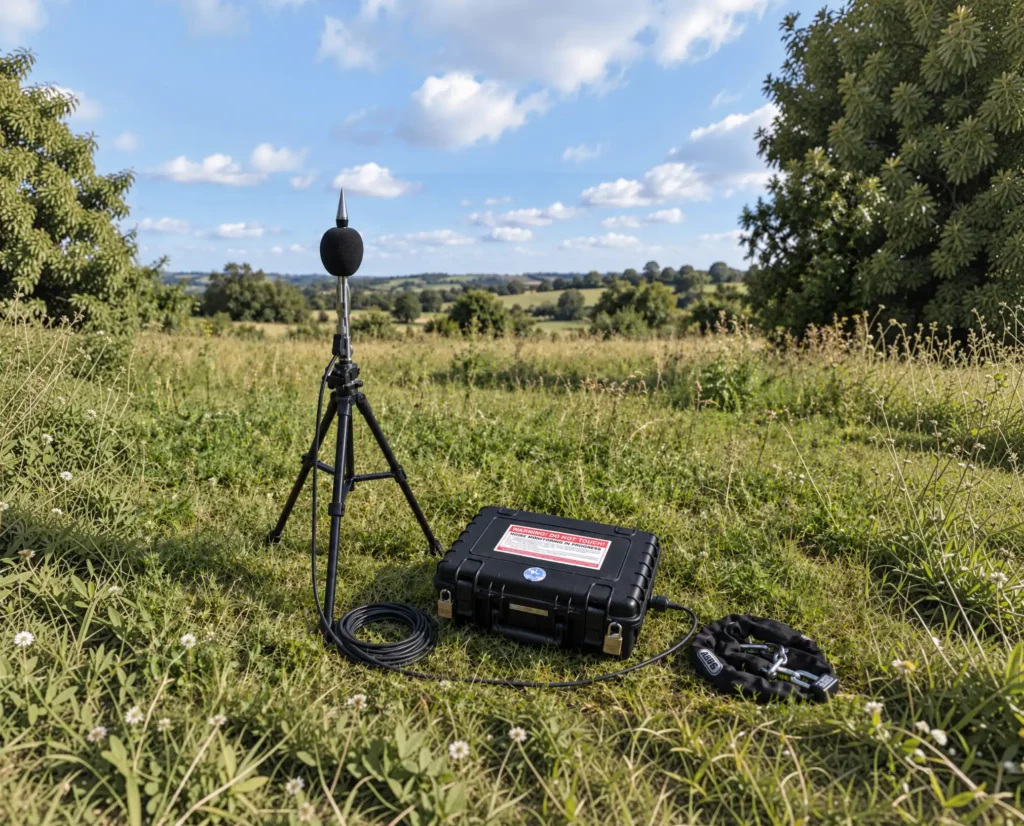
A survey may involve installing calibrated sound monitoring equipment at the site for a representative period, often including daytime and night-time measurements. For some projects, attended measurements of particular noise sources may also be required.
The measured data is then analysed alongside the proposed development, relevant guidance and appropriate acoustic standards to determine whether mitigation or design measures are necessary.
The appropriate methodology depends on the project. Assessments may refer to standards and guidance including BS 4142, BS 8233, BS 5228, ProPG, MCS 020 and other relevant national or local planning guidance.
We determine the appropriate assessment methodology from the development proposals, site conditions and any requirements specified by the Local Planning Authority or Environmental Health Officer.
Yes. An acoustic assessment can be undertaken before submission to identify potential constraints early and determine whether noise mitigation needs to be incorporated into the design.
For some developments, addressing noise at the design stage can be considerably simpler than responding to acoustic issues after the planning application has already been submitted.
Whilst common, this is not a default requirement.
Many planning noise assessments require measurements at the development site or nearby noise-sensitive receptors. However, some assessments can be completed using manufacturer data, existing survey information, acoustic modelling or other suitable information.
We will advise whether a site visit and noise survey are required once we have reviewed the project information.
This depends on the type of assessment and the acoustic environment.
Environmental noise surveys are commonly undertaken over at least 24 hours, although longer monitoring periods may be appropriate where noise conditions vary between weekdays and weekends or where representative operating conditions need to be captured.
Shorter attended measurements may be sufficient for some plant, machinery or specific-source assessments.
Timescales depend on the complexity of the project, survey requirements and current availability. We will confirm the anticipated programme when providing your quotation.
Where a noise survey is required, the report is normally prepared after monitoring has been completed and the measurement data has been reviewed. Our typical lead times vary between 1 and 3 weeks, however we can work to any specific deadlines you might have.
The cost depends on the type of assessment, site location, monitoring requirements, number of noise sources or receptors, acoustic modelling requirements and the complexity of the planning submission.
Providing the site address, drawings and relevant planning correspondence when you contact us allows us to provide a more accurate fixed-fee quotation.
Yes. Noise from mechanical and electrical plant, air-conditioning systems, extraction equipment and heat pumps can be assessed against the appropriate planning and acoustic criteria.
Depending on the circumstances, this may involve a BS 4142 assessment, MCS 020 assessment, site noise measurements, manufacturer sound data or acoustic modelling.
Yes. Where mitigation is required, the report can identify practical acoustic measures appropriate to the development.
Depending on the project, this could include acoustic barriers or enclosures, plant attenuation, equipment relocation, façade sound insulation, alternative ventilation strategies or changes to operating conditions.
Where appropriate, acoustic modelling can be used to predict how sound propagates between noise sources and surrounding receptors.
This can be particularly useful for developments involving multiple noise sources, complex site layouts, screening structures or several nearby residential properties. Modelling can also be used to compare mitigation options before they are implemented.
Polaris Acoustics undertakes acoustic consultancy projects across the UK. For projects requiring a noise survey or site inspection, travel requirements will be considered when preparing the quotation. Previously served areas also include the Channel Islands and Ireland.
We will review the information provided, identify the likely acoustic requirements and contact you if anything further is needed.
Where the scope can be established from the information supplied, we will provide a quotation setting out the proposed survey, assessment methodology, reporting scope and anticipated timescale.
Noise Impact Assessments for Planning Applications
Polaris Acoustics provides environmental and building acoustics consultancy for planning, development and noise-control projects across the UK. Explore our core services below, including noise impact assessments, industrial and commercial noise assessments, construction noise and vibration, building acoustics and acoustic modelling.
Learn moreMIOA · BS 8233 · BS 4142 · ProPG · UK-Wide Consultancy
