
Acoustic consultancy for planning, design and compliance
Clear, robust acoustic evidence to support planning applications, discharge planning conditions and answer Environmental Health.
Polaris Acoustics helps developers, architects, planning consultants and property owners with acoustic surveys, noise impact assessments and acoustic reports for planning, from BS 8233 residential assessments to BS 4142 plant noise and BS 5228 construction noise.
MIOA acoustic consultant
UK-wide service
Planning-ready reports
Fixed-fee quotes
Prefer to speak first?


Why it matters
Every planning application near a road, a railway, a pub or a heat pump asks one quiet question: will noise harm anyone? An acoustic report answers it with evidence.
Acoustic surveys and noise impact assessments
Polaris Acoustics provides acoustic surveys and planning noise assessments for residential, commercial and mixed-use development across the UK. We support projects at feasibility, planning, detailed design and condition discharge, identifying site constraints early and defining the assessment needed for a clear, robust submission.
Our work includes baseline noise surveys, noise impact assessments and detailed appraisals to BS 8233:2014, BS 4142:2014+A1:2019 and, where relevant, ProPG, BS 5228 and ISO 9613-2. The focus is always practical, planning-ready advice that planning officers, Environmental Health, architects and developers can rely on. See how councils review noise survey reports.
Get in touchWritten to BS 8233, ProPG, BS 4142 and BS 5228, in the format planning officers and Environmental Health expect to see.
A clear scope and a fixed fee before any work starts, usually within 24–48 hours of your enquiry.
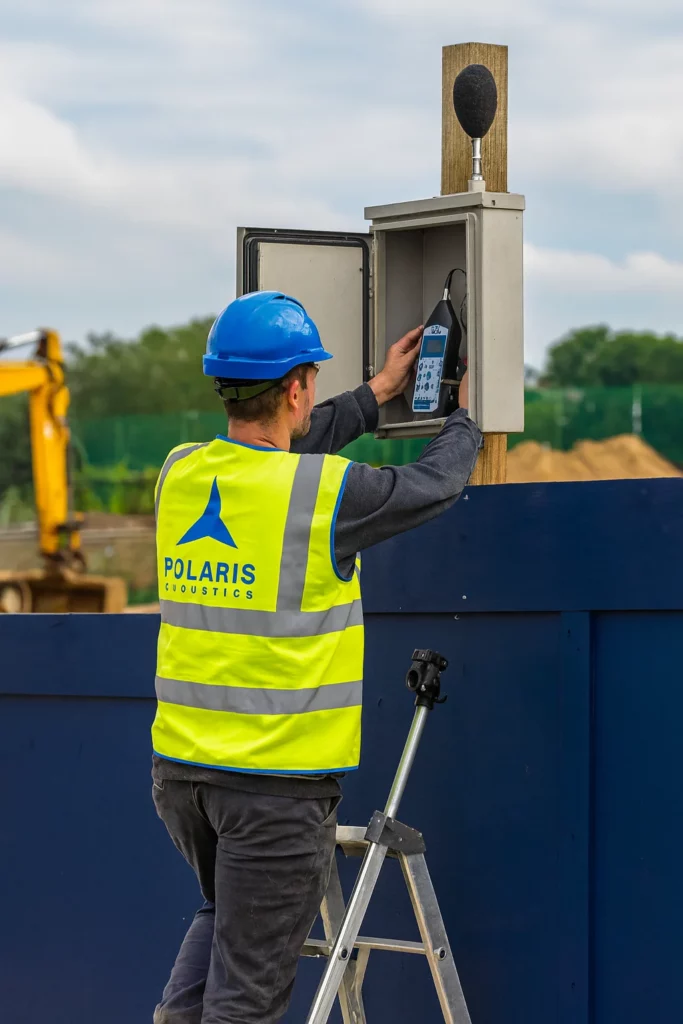
Calibrated Class 1 sound level meters for attended and unattended monitoring, timed to capture the day and night noise that matters.
Proportionate, buildable advice on glazing, ventilation, barriers and plant, never over-engineered specifications that inflate build costs.
Common planning scenarios
Many developments need a noise survey or noise impact assessment before planning permission can be granted or conditions discharged. These are the situations we assess most often.
Not sure which applies? Send us the site address and we'll confirm the right scope before you commit. Our guide explains how often a noise survey is required.
Ask about your siteResidential developments
Homes near roads, railways, flight paths or industry need an acoustic assessment to set glazing, ventilation and garden design before planning can be granted.
Assessment: BS 8233 and ProPG residential noise assessment
Commercial and industrial plant
Plant, equipment and operational sound may need a noise impact assessment to support a planning application or discharge conditions.
Assessment: BS 4142 plant noise assessment
Heat pumps and mechanical services
Heat pumps, condensers and ventilation plant often need assessing to show acceptable noise at neighbouring homes.
Assessment: MCS 020(a) and BS 4142
Pubs, bars and entertainment uses
Music, patron and servicing noise from bars, restaurants and venues, and new homes planned beside them under the Agent of Change principle.
Assessment: entertainment noise assessment
Construction and development sites
Demolition and construction may need noise and vibration assessment for planning conditions, Section 61 consent or site management.
Assessment: BS 5228 construction noise and vibration
Sport and leisure
Padel courts, MUGAs and sports facilities, from ball strikes and voices to floodlit evening use, assessed at neighbouring homes.
Assessment: sports noise assessment and mitigation
Acoustic consultancy services
Planning-focused acoustic reports for residential, commercial, industrial and mixed-use developments across the UK, designed to support planning applications, condition discharge and Environmental Health consultation. Not every application needs the same evidence, so we confirm whether you need a baseline survey, a BS 8233 or BS 4142 assessment, construction noise advice or a focused report for condition discharge before any work starts.
The usual acoustic report for planning where a development may be exposed to noise, introduce new noise sources or need mitigation.
Noise impact assessments →
For homes, flats and conversions: internal rooms, external amenity, façade design and ventilation strategy.
Environmental noise surveys →
For HVAC plant, condensers, refrigeration, heat pumps and commercial sound affecting nearby homes.
Plant noise assessments →
For demolition and construction where temporary noise and vibration must be assessed, managed or monitored.
Construction noise →
MCS 020(a) checks and BS 4142 assessments for air source heat pumps outside permitted development.
Heat pump assessments →
Acoustic assessments for padel courts and sports facilities, with barrier, layout and hours-of-use advice.
Padel noise assessments →
Development sectors
Every assessment is shaped by the type of development, the surrounding acoustic environment and what the local authority will expect to see. Choose a development type to see the typical scope, standards and outputs.
We carry out residential noise surveys for new-build housing, apartment schemes, conversions, refurbishments and Class MA permitted development, assessing how road, rail, commercial and plant noise will affect future occupiers.
Typical scope includes a BS 8233 assessment of internal rooms and outdoor amenity areas, façade sound insulation and glazing advice, ventilation strategy input and, where relevant, a BS 4142 assessment of heat pumps or other external plant.
The aim is a clear acoustic strategy that supports the planning submission, informs the design and demonstrates suitable living conditions.
Typical standards
BS 8233:2014ProPGBS 4142:2014+A1:2019
Typical outputs
Noise survey for planningAcoustic assessment reportFaçade, glazing and ventilation advice
How it works
One consultant from first call to final sign-off. Scroll to follow a typical project.
01
Send the address, drawings and any comments from the council or Environmental Health. We reply within 24–48 hours.
02
We confirm which assessment the council will expect (BS 8233, BS 4142, BS 5228 or a combination) and send a fixed fee, so there are no surprises.
03
Attended and unattended monitoring with Class 1 sound level meters, usually within 3–5 working days of instruction, timed to capture the noise that matters.
04
Measured data assessed against the relevant standards and policy, with ISO 9613-2 noise modelling where plant or site layout needs it.
05
A clear, defensible report with the findings, mitigation and the evidence a planning officer or Environmental Health Officer needs to sign it off.
06
We answer consultee queries, revise the report where needed and help discharge noise conditions, so your project keeps moving.
Most projects go from enquiry to a submitted report in two to three weeks.
Request a quoteRecent approvals
A selection of recent schemes where our noise assessment formed part of the application. Every decision can be checked on the council's own planning register.
Granted
A shop converted to a café by day and a bar by evening, beside homes. We assessed plant, music and patron noise, set a 41 dB plant limit at the nearest windows and defined the sound insulation scheme. The noise conditions were later discharged.
Eastleigh Borough Council · F/26/101048 · 2026
Approved
A warehouse converted to a three-court padel centre open 06:00–22:00, seven days a week. Predicted court noise at the nearest homes was more than 30 dB below the guideline level, well within the council's own thresholds.
Durham County Council · DM/26/00487/FPA · 2026
Granted
Environmental noise survey, ProPG risk assessment and BS 8233 assessment for a 42-apartment retirement scheme, with a practical glazing, ventilation and overheating strategy for detailed design.
Cumberland Council · FUL/2025/0183 · 2026
★★★★★
“Two quite different jobs, and he handled both superbly… Council liaison and any amendments the planners might ask for were included in the fixed fee… Flexible, thorough, patient, and genuinely invested in getting us the right outcome rather than just producing a document.”
Tom Bradshaw · BS 4142 heat pump assessments, Hackney and Islington
★★★★★
“Fast, efficient, and delivered on what was promised. Professional, friendly and accommodating.”
Paul Lewis · Google review

Who you'll work with
Polaris Acoustics is led by Mathew Vaughan MSc MIOA, a Full Member of the Institute of Acoustics with an MSc in Applied Acoustics. Before founding Polaris, Mathew spent four years at Hawkins Environmental delivering noise assessments for residential, commercial and industrial schemes across the UK.
There's no hand-off to a junior. The person who scopes your project is the one who carries out the survey, runs the model, writes the report and answers the council's questions. That's why the reports stand up to scrutiny.
MIOA
Full Member, Institute of Acoustics
MSc
Applied Acoustics, Solent University
Class 1
Calibrated survey instrumentation
UK-wide
England, Scotland, Wales and NI
Areas we serve
Based in Southampton and working nationwide, with most projects in London, the South East and the South West. Each regional page covers local planning considerations and the noise sources we see most often there. We also support projects in Portsmouth, Brighton, Oxford, Cardiff, Glasgow, Edinburgh, Liverpool, Leeds, Nottingham, Leicester, Coventry and across the wider UK.
London
Noise surveys across all 32 boroughs and the City
→
South East
Kent, Surrey, Sussex, Berkshire and the Thames Valley
→
South West
Bristol, Bath, Devon, Cornwall and Somerset
→
Cambridge
Cambridge, South Cambridgeshire and East Anglia
→
West Midlands
Birmingham, Coventry and the wider Midlands
→
East Midlands
Nottingham, Leicester, Derby and Lincoln
→
North West
Manchester, Liverpool and Lancashire
→
North East
Newcastle, Sunderland, Durham and Teesside
→
Wales
Cardiff, Swansea, Newport and rural Wales
→
Scotland
Edinburgh, Glasgow and across Scotland
→
Northern Ireland
Belfast and across Northern Ireland
→
Latest guides
Plain-English guidance on noise surveys, acoustic reports, standards and costs, written by Mathew from real project experience.
FAQs
Straight answers to the questions we hear most from developers, architects and homeowners.
An acoustic report for planning (also called a noise impact assessment) shows the planning authority whether noise will affect a proposed development, or whether the development will create noise that affects others. It sets out the survey results, assesses them against standards such as BS 8233, ProPG or BS 4142, and recommends any mitigation needed. See our noise impact assessments for planning.
Usually when new homes are proposed near a noise source such as a road, railway, airport, pub or industrial site; when a development introduces new noise such as plant, heat pumps, extraction or a sports facility; or when the council or Environmental Health asks for one at validation or as a planning condition. Our guide explains how often a noise survey is required.
Simple noise assessments can start from around £750, and a planning noise survey and report for a small-to-medium project commonly costs £1,000–£2,500+. The fee depends on how long monitoring needs to run, the number of measurement positions and what the council requires. We always provide a fixed-fee quote before any work starts. Our guide to noise assessment costs explains the main price factors.
Site visits are typically arranged within 3–5 working days. Monitoring usually runs for 24 hours to a week depending on the noise sources, and the report normally follows within 5–10 working days of the survey. Urgent timescales can often be accommodated.
BS 8233 sets guidance for acceptable noise levels inside and around homes and other buildings, and is used to design glazing, ventilation and gardens for new housing. BS 4142 assesses the impact of industrial and commercial sound, such as plant and machinery, on nearby residents by comparing it with the existing background sound level.
Often not, if the installation qualifies as permitted development, which includes meeting the MCS 020(a) noise standard at the nearest neighbour. If it does not qualify, planning permission may be needed and the council may ask for a noise assessment. See our guide to reducing heat pump noise.
Reports are written to the standards and policy that planning officers and Environmental Health Officers use, with transparent methodology and calibrated Class 1 measurements. If a consultee raises questions, we respond and revise the report where needed as part of the service.
Yes. We are based in Southampton and work across the UK, including London, the South East, the South West, the Midlands, the North, Wales, Scotland and Northern Ireland.
The site address, a short description of the proposal, any drawings, and any comments or conditions from the council or Environmental Health. With those, we can confirm the right scope and send a fixed-fee quote, usually within 24–48 hours.
Start your project
Send us the site address, drawings and any comments from the council or Environmental Health. We'll confirm exactly which assessment you need and send a fixed-fee quote, usually within 24–48 hours.
MIOA acoustic consultant · Class 1 instrumentation · Fixed fees · UK-wide