
Environmental noise surveys, carried out in line with BS 8233:2014, are essential for residential and mixed-use developments where planning authorities require evidence that future occupants will be protected from excessive noise. At Polaris Acoustics, our IOA-accredited consultants provide clear, evidence-based assessments and reports that support planning applications, discharge conditions, and ensure compliance with national and local guidance & standards.
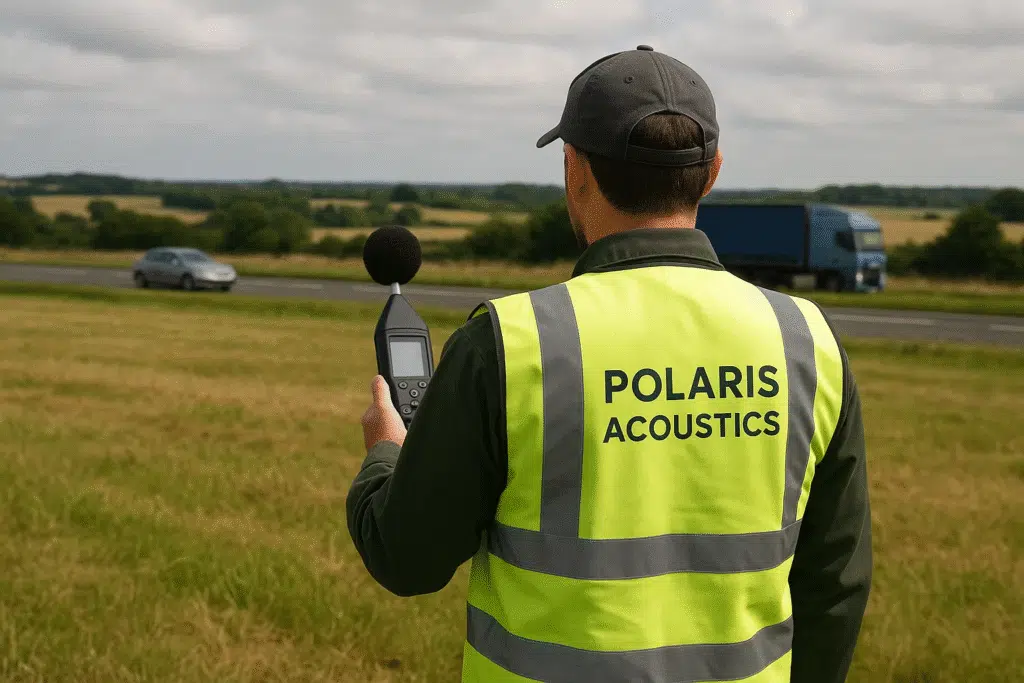
Environmental noise surveys are a key part of demonstrating that new residential and mixed-use developments will provide acceptable living conditions for future occupants. Planning authorities often require evidence that external noise sources such as road traffic, railways, or commercial activity have been fully assessed.
Using BS 8233 and relevant local guidance, we measure existing environmental noise, assess impacts, and recommend practical mitigation such as façade design, glazing, and ventilation strategies. Our clear, evidence-based reports provide the documentation needed for planning submissions, helping you achieve compliance, minimise objections, and keep your project moving forward.
Our suitably qualified team carries out environmental noise surveys in line with BS 8233 and relevant planning guidance to assess the suitability of sites for new residential and mixed-use developments. By measuring existing environmental noise — from sources such as road, rail, aircraft, and commercial activity — we determine whether proposed dwellings can meet the required internal and external noise standards.
We then provide clear, evidence-based reports for planners, local authorities, and stakeholders. These include detailed assessments and practical mitigation recommendations, such as façade design, glazing, and ventilation strategies. This gives you the documentation needed to demonstrate compliance, secure planning consent, and reduce the risk of objections or costly redesigns.
Planning authorities often require environmental noise surveys to demonstrate that new residential or mixed-use developments will provide acceptable living conditions. Without this evidence, applications risk refusal, delays, or costly objections from environmental health officers.
A BS 8233 noise assessment measures existing environmental noise from sources such as traffic, railways, aircraft, or nearby commercial activity. Our reports translate this data into practical design advice — including façade layouts, glazing specifications, and ventilation strategies — ensuring compliance with national standards and local planning policy.
By commissioning an environmental noise survey early, you reduce risk, strengthen your planning application, and keep your development on track.
Our team provides BS 8233–compliant residential acoustic surveys and environmental noise assessments to support planning applications and discharge conditions. We help developers, contractors, and planning consultants demonstrate compliance, minimise risks, and keep projects progressing without costly delays.
BS 8233 environmental noise surveys and intrusive sound testing to assess site suitability and support residential planning applications.
Noise impact assessments for residential and permitted development schemes. Demonstrate compliance with planning policy.
Evidence your planning application with a detailed BS 8233 noise assessment report. We provide predictions and mitigation advice to meet BS 8233.
Support with discharging noise-related planning conditions. Our evidence-led reports satisfy local authority requirements and reduce risk of objections or delays.
All consultants are MIOA and CSCS certified.
Explore expert guidance on noise assessments, acoustic reports, and planning compliance. Our blog is written by IOA-accredited acoustic consultants, offering straightforward advice you can rely on. Covering residential, commercial, and public sector developments, we share insights on managing noise impacts, achieving compliance with BS 8233 and BS 5228, and keeping projects moving smoothly from planning to delivery.
From first enquiry through to planning submission, our step-by-step approach makes environmental noise surveys straightforward and transparent. Every stage is designed to meet planning authority requirements, support BS 8233 compliance, and keep your project moving without costly delays.
We begin with an initial discussion to understand your development and requirements.
Receive a clear proposal and scope of works, with tailored costs to meet your projects needs.
Baseline environmental noise surveys carried out on site to establish existing conditions.
Noise assessments prepared in line with BS 8233, with mitigation measures where required.
Clear, evidence-based acoustic reports aligned to BS 8233 for submission with your planning application.
Ongoing advice to help discharge planning conditions and satisfy planning requirements.
The cost of an environmental noise survey depends on your project’s requirements. Factors that influence price include:
The type of assessment (baseline noise survey or full BS 8233 acoustic report)
The duration of monitoring (daytime, evening, overnight, or multi-day surveys)
The number of monitoring locations required
The level of reporting detail and any mitigation advice
At Polaris Acoustics, we provide clear, competitive pricing with no hidden extras. Our IOA-accredited consultants deliver reliable surveys and robust BS 8233 reports to satisfy planning authorities. This ensures compliance, reduces the risk of objections, and helps your development move forward without costly delays.
If you’re planning a residential or mixed-use development and need to demonstrate compliance with BS 8233, you may have questions about what an environmental noise survey involves.
From how surveys are carried out, to what goes into an acoustic report, here are answers to the most common queries we receive from developers, architects, and planning consultants.
An environmental noise survey measures existing sound levels around a site to quantify baseline conditions and predict noise impact from or on a proposed development. Using a Class 1 sound level meter, we record LAeq,T (ambient), LA90,T (background) and LAFmax (maxima) over representative day (7am to 11pm) and night (11pm to 7am) periods and interpret the data against BS 8233:2014, BS 4142:2014+A1:2019, ProPG: Planning & Noise and local policy.
For planning, the output is a noise impact assessment (NIA). This is suitable for submission: calibrated data, monitoring plan and photos, time histories/spectra, plant noise rating level versus background sound level, acoustic modelling if required, and mitigation design (façade/glazing & ventilation strategy, screening and layout).
Not automatically. However, it is often required via planning to determine site suitability. Otherwise, for pre-validation, pre-commencement or pre-occupation conditions. A noise survey may also be useful for premises licensing, as well as construction noise/vibration management.
Typical triggers include noise-sensitive uses near transport/industry noise sources, or new fixed plant (HVAC, ASHPs, chillers, fans) close to neighbours.
Construction phases may need a Section 61 application (Control of Pollution Act 1974). Note: occupational noise (Noise at Work) is a separate regime; domestic heat pumps may be checked using methods such as MCS 020 under permitted development.
Takeaway: check your Local Planning Authority (LPA) validation list and policy; most urban sites benefit from a survey at pre-app or at either the 2nd or 3rd RIBA stage.
Road traffic (e.g. A-roads, junctions, braking, HGVs).
Rail and aircraft (e.g. pass-bys, station activity, flight paths).
Industrial/commercial plant (e.g. HVAC, condensers, compressors, extract fans).
Construction/demolition (e.g. piling, breakers, generators, site traffic).
Leisure/entertainment (e.g. amplified music breakout, outdoor seating, patron noise).
Fees scale with site complexity, number of positions, night monitoring, and whether modelling/mitigation and condition drafting are included. As a general pricing guide:
Baseline survey (small site, 1–2 positions): ~£1,200–£1,800+
Planning/BS 4142 plant noise impact assessment (with mitigation/modelling): ~£1,200–£3,500+
Complex/multi-day or multi-source/EIA support: £3,500+
What improves value: a site plan, proposed layouts/uses, plant schedules or sound power data, nearest NSRs, and any planning refs/conditions. Expect a fixed, scope-tied quote with deliverables, submission-ready figures and suggested condition wording.
Likely yes if you are: bringing forward residential or mixed-use near roads/rail/industry; changing use to dwellings; installing external plant (ASHPs, condensers, extraction); preparing a construction noise strategy (BS 5228 / Section 61); seeking a premises licence for amplified music/outdoor areas; or responding to EHO queries/complaints.
BS 8233:2014 gives UK guidance on sound insulation and noise reduction for buildings. It sets internal ambient noise design targets typically used in planning decisions e.g. living rooms 35 dB LAeq,16h, dining rooms 40 dB LAeq,16h, bedrooms 30 dB LAeq,8h (night) and advice on achieving them via façade, layout and ventilation.
For external amenity, it cites a desirable 50 dB LAeq,16h with an upper guideline of 55 dB LAeq,16h (context-dependent). In practice it’s applied alongside ProPG (residential risk & design) and BS 4142 (industrial/plant noise) to evidence acceptability and shape planning conditions.
Speak to an experienced acoustic consultant today for a fast, free quote. We provide clear advice and BS 8233 compliant noise surveys and acoustic reports to help you meet planning obligations and satisfy local planning authority requirements efficiently — anywhere in the UK.