
Polaris Acoustics delivers plant noise assessments and surveys using BS 4142:2014+A1:2019. The assessments are designed for new plant installations, such as: HVAC, air-source heat pumps, condensers, chillers, extract/MVHR fans and rooftop M&E plant. Our IOA-accredited consultants measure LA90 background sound, predict plant rating levels (with tonal/impulsive/intermittency corrections) at the nearest noise-sensitive receptors, and set clear LPA-compliant limits. You’ll receive a planning-ready report with practical mitigation—screens/enclosures, silencers, low-noise selections and operating schedules—to secure approval and discharge planning conditions quickly.
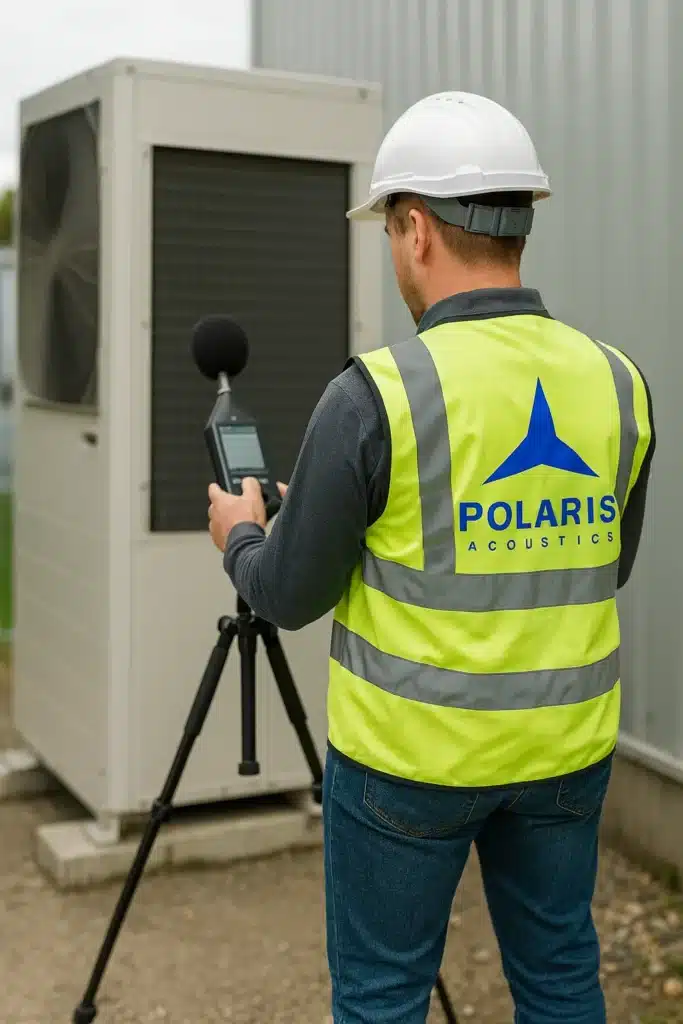
Adding or upgrading HVAC, ASHPs, chillers, condensers, extract/MVHR fans or rooftop plant? Most LPAs expect a BS 4142:2014+A1:2019 assessment to prove neighbour amenity is protected. We manage the whole journey—scope, measurements, modelling, and close-out.
How we can help:
Setting of clear plant noise limits (day/evening/night) at each noise sensitive receptor.
A concise acoustic report that details the impact of plant and any mitigation requirements.
A mitigation schedule with expected dB reductions you can procure against.
Optional condition wording, EHO/LPA liaison, and post-install verification to discharge conditions.
Our suitably qualified team carries out plant noise surveys and BS 4142:2014+A1:2019 assessments for fixed M&E plant (HVAC, ASHPs, condensers, chillers, extract/MVHR fans and rooftop kit). We measure LA90 background sound, predict specific and rating levels at the nearest receptors (including tonal/impulsive/intermittent corrections), and assess context to meet Local Planning Authority limits.
We then provide clear, planning-ready reports with quantified mitigation—screens/enclosures, silencers, re-siting, operating schedules and low-noise selections—plus optional 3D modelling and low-frequency/tonal diagnostics for substations and transformers. This gives you the evidence to demonstrate compliance, secure consent, discharge conditions, and keep your project moving without costly redesigns.
Councils often ask for a BS 4142 plant-noise assessment to prove new building services equipment—like heat pumps, fans, chillers and condensers—won’t disturb nearby homes or offices. If you don’t provide this evidence, your planning application can be delayed or refused, and you may get objections from Environmental Health.
The assessment is simple to understand: we measure the area’s usual background noise (LA90) by day/evening/night, then predict how loud your plant will be at the nearest properties. If the sound has a whine, bangs, or keeps starting and stopping, we add small penalties—this gives a rating level. We compare that with the background to check if it meets council limits and, if not, we suggest practical mitigation (move the unit, add a screen/silencer, use quiet/night mode). For kit like substations/transformers, we also check low-frequency hum. Doing this early reduces risk and keeps your project on track.
Keep projects moving and secure LPA approval with BS 4142 plant noise surveys and assessments. We cut planning risk and demonstrate compliance for developers, contractors and planning consultants.
Baseline noise monitoring to determine the existing noise levels. Measurement of plant noise in accordance with BS 4142 to determine the specific sound levels.
Prediction of the specific and rating levels for HVAC, ASHPs, condensers, chillers, extract fans and rooftop plant. Determination of suitability and mitigation.
Evidence your planning application with a detailed BS 4142 noise assessment report. We provide predictions and mitigation advice to meet British Standard BS 4142.
Targeted FFT analysis for substations, transformers and large chillers to diagnose LF hum and tones. Modelling and determining mitigation.
All consultants are MIOA and CSCS certified.
Discover practical guidance on noise assessments, BS 4142 reports, and planning compliance. Written by IOA-accredited acoustic consultants, our blog provides clear, no-nonsense advice you can trust. We cover residential, commercial, and public sector projects, sharing insights on managing plant noise, meeting planning conditions, and ensuring compliance with BS 4142, BS 8233, and BS 5228. Whether you’re a planner, developer, or homeowner, our articles help you reduce risk, avoid delays, and keep projects moving smoothly from design through to delivery.
From first enquiry to condition discharge, our step-by-step approach makes plant noise surveys straightforward and transparent. Every stage aligns with BS 4142:2014+A1:2019 and Local Planning Authority requirements to demonstrate compliance, minimise objections and keep your programme moving.
We begin with an initial discussion to understand the proposed plant, scheme and requirements.
Receive a clear proposal and scope of works, with tailored costs to meet your needs.
Baseline noise surveys carried out on site to establish existing acoustic conditions.
Noise assessment prepared with BS 4142 and identify mitigation measures.
Clear, evidence-based acoustic reports aligned to BS 4142 for internal use or planning.
Post-installation verification to sign off compliance and discharge planning conditions.
The cost of a plant noise survey and BS 4142:2014+A1:2019 assessment depends on scope and site complexity. Typical small schemes start from ~£700 + VAT; multi-source or modelled projects are ~£1,200–£3,500 + VAT.
What affects price
Assessment type: screening vs full BS 4142 Noise Impact Assessment
Monitoring: day/evening/night coverage; single or multi-day
Locations/receptors: number of positions and access constraints
Modelling & mitigation: 3D propagation, octave-band analysis, screens/silencers, time controls
Extras: EHO/LPA liaison and post-installation verification
At Polaris Acoustics, pricing is clear and fixed-scope with no hidden extras. Our IOA-accredited team delivers planning-ready BS 4142 reports that satisfy LPAs, reduce objections and help discharge conditions quickly. For a fixed quote, send a site plan, plant schedule/sound power data, operating hours and nearest receptor locations.
If you’re planning a residential or mixed-use development and need to demonstrate compliance with British Standard BS 4142, you may have questions about what a plant noise survey and assessment involves.
From how surveys are carried out, to what goes into an acoustic report, here are answers to the most common queries we receive from developers, architects, and planning consultants.
A BS 4142 assessment predicts and rates noise from fixed mechanical/electrical (M&E) plant at the nearest noise-sensitive receptors.
We compare the plant rating sound level (which includes decibel penalties for tonality/impulsivity/intermittency and other acoustic features) with the representative background sound level (LA90) to estimate the impact and advise mitigation for planning permission and condition discharge.
We (1) agree scope and receptors, (2) measure representative LA90 day/evening/night, (3) calculate plant sound power, or measure on-site (or obtain data from the manufacturer data sheets), (4) predict the specific sound levels at the nearest noise sensitive receptors, apply any relevant BS 4142 feature penalties, (5) assess context/uncertainty, and (6) provide a planning-ready report with clear limits and mitigation to best support your project.
Typical fees ranges:
Click here to contact us and share a site plan, plant schedule and operating hours for a fixed quote.
Background (LA90): the usual noise in the area when nothing special is happening — the level heard most of the time (this is measured over 1 hour intervals by day or 15 minutes at night).
Specific (LpAeq,Tr): the worst-case operational noise from the plant/equipment only (e.g., a heat pump or fan), averaged over the same time.
Rating (LAr,Tr): the specific level plus a dB penalties — if the sound has distinct features (e.g. a whine, bangs/clicks, or it keeps starting/stopping).
You’ll usually need one when any fixed plant (HVAC units, heat pumps, chillers, extract fans, rooftop kit) could be heard at nearby homes or offices, especially if:
You’re making a planning application and the council (LPA) asks for noise evidence.
You’re adding or replacing plant close to neighbours (new ASHP, condenser, kitchen extract, etc.).
There’s a noise complaint or an Environmental Health officer has been in touch.
You need to discharge a planning condition about plant noise.
The site is quiet at night or densely built, so even small plant might stand out.
You’re unsure if the design meets local noise limits and want to avoid delays.
A BS 4142 assessment compares the plant noise with the usual background at the nearest homes and then suggests mitigation (screens, silencers, re-siting, time controls) if needed.
The MCS check doesn’t pass, or your council asks for extra evidence.
You live in a flat, a conservation area, or the unit is very close to a neighbour.
You’re installing more than one unit (or a big unit) and noise could add up.
In these cases, a BS 4142 assessment from an acoustic consultant gives the council a planning ready report and clear mitigation options.
Speak to an experienced acoustic consultant today for a quick and free quote, with no obligation. We provide clear advice and BS 4142 compliant noise surveys and acoustic reports to help you meet planning obligations and satisfy local planning authority requirements efficiently — anywhere in the UK.