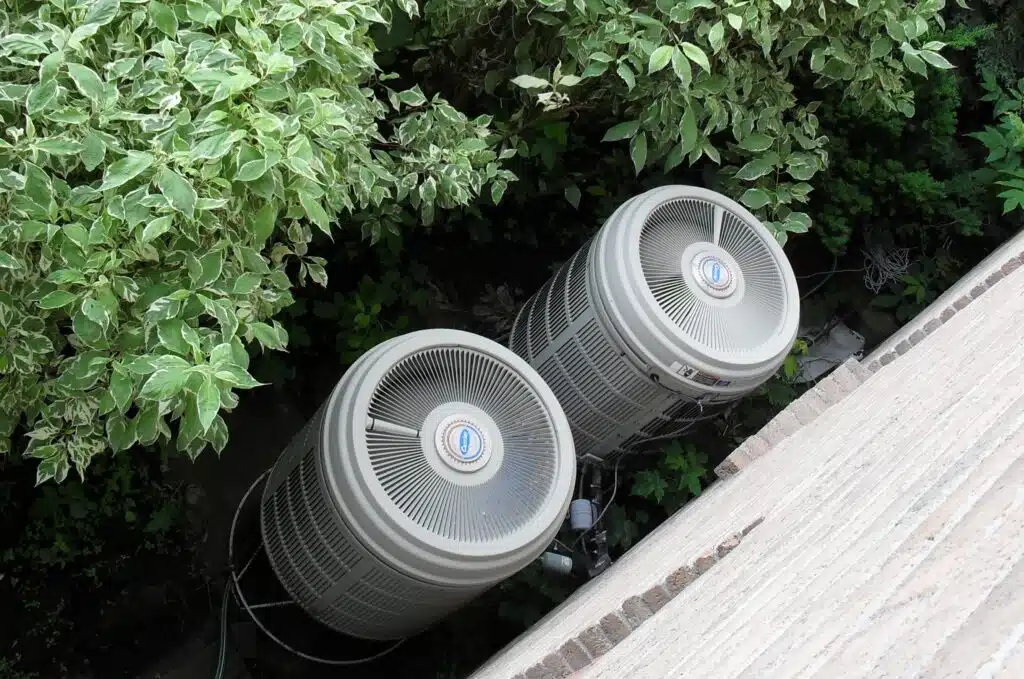
Acoustical control is about far more than just “making things quieter.” In modern planning and building design, it’s about shaping how sound behaves — both inside buildings and in the wider environment. This is done by different types of acoustic control.
From traffic noise spilling into new homes, to plant equipment disturbing nearby residents, to reverberation inside plant rooms or offices — every acoustic challenge requires a tailored noise control strategy to ensure that noise can be mitigated, minimised or avoided entirely.
In the UK, the importance of good acoustic design and acoustical control is reinforced by:
- The National Planning Policy Framework (NPPF) and Noise Policy Statement for England (NPSE) — which require noise to be mitigated to avoid adverse impacts.
- Building Regulations Part E — setting minimum sound insulation standards.
- BS 8233, BS 4142, BS 5228, and ProPG — providing the technical basis for design and assessment.
This blog article explores the four main types of acoustical control used in both environmental noise control and building acoustics, such as sound absorption and isolation:
- Absorption
- Diffusion
- Isolation
- Barrier Attenuation
1. Sound Absorption and Isolation: Managing Reverberant Noise

What is Sound Absorption and Isolation?
Sound absorption reduces the amount of sound energy reflected within an enclosed space. It converts sound energy into a small amount of heat energy through friction within porous materials. Isolation refers to the prevention of acoustic energy propagating between spaces that feature a separating element. Whilst the to are separate principles, sound absorption is often use to help improve the isolation of a party wall or separating floor.
In environmental noise control, absorption is often used to reduce reflected noise from hard surfaces — such as inside plant enclosures, service yards, or under canopy structures — preventing excessive reverberation that can amplify sound levels. It is also very common to see sound absorbing materials being incorporated within acoustic barrier structures that might be situated to reduce road traffic noise from a busy road, such as the M25.
In building acoustics noise control, it improves speech clarity, comfort, and compliance with standards such as BB93 (Schools) and HTM 08-01 (Healthcare). This is particularly important for auditoria, stadiums, hospitals and educational facilities.
Why Sound Absorption and Isolation Matter
Without sufficient absorption, noise builds up through multiple reflections. In plant rooms, this can elevate background noise by 3–8 dB, increasing external breakout. In offices, it can make speech unintelligible and fatiguing.
With a lack of acoustic isolation, this can result in concerns over privacy and issues relating to nuisance. At Polaris Acoustics, we often get asked to provide assessments to help with complaints of nuisance noise. In almost all requests like this, we often highlight to our clients that the principle issue is in regard to the sound attenuation afforded by a party or separating wall or floor.
By strategically adding absorptive finishes, the reverberation time (RT₆₀) can be controlled and improved isolation can be achieved, ensuring both comfort and compliance.
Common Absorptive Materials
- Mineral wool or foam panels — used within plant rooms and acoustic enclosures. Also beneficial in auditoria or home/professional studios.
- Fabric-wrapped wall or ceiling panels — for offices, classrooms, and meeting spaces.
- Perforated metal panels with backing insulation — ideal for industrial or service areas.
- Acoustic ceiling tiles and baffles — improving clarity in large, open spaces.
Example – Plant Room in Bromley, London:
A mechanical plant room in Bromley, London, adjacent to a residential block measured 76 dB(A) near to the operating equipment. By adding wall and ceiling absorptive materials (αw ≥ 0.9), internal reverberant levels reduced by 11 dB, allowing smaller air paths and lighter plant room louvre, designs while still achieving external noise limits under BS 4142 at the nearest noise sensitive premises.
Guidance and Standards for Sound Absorption and Isolation
- BS 8233:2014 – Recommends internal ambient noise levels for various room types.
- BS 5228-1 – Highlights absorption as a mitigation measure during construction.
- CIBSE Guide B5 – Addresses reverberation in mechanical and electrical plant areas.
2. Sound Diffusion: Equalising Reflections and Acoustic Energy
What is Sound Diffusion?
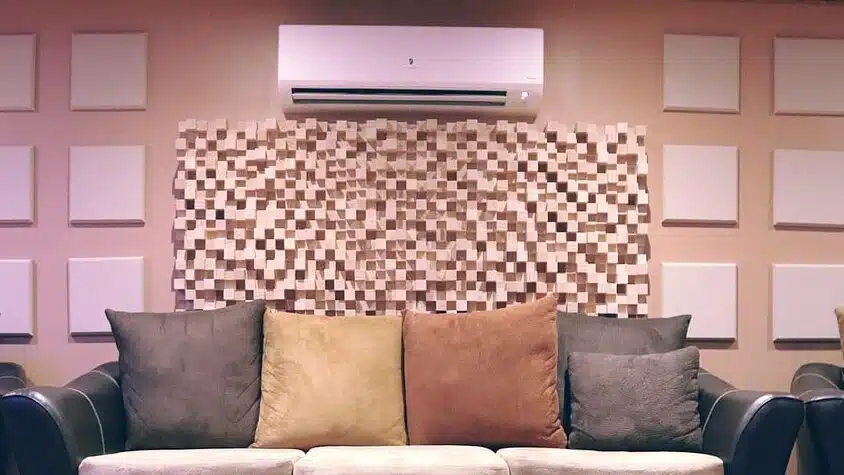
Sound diffusion scatters reflected sound energy, spreading it more evenly across a space rather than allowing strong reflections to dominate.
While more commonly discussed in room acoustics (e.g. studios, performance spaces), diffusion can also benefit semi-enclosed environmental spaces like atria, undercrofts, or public concourses.
Why Sound Diffusion is Important
Too much absorption can make a room feel acoustically “dead.” Diffusion maintains a balanced, natural sound field, and helps to avoid harsh ‘specular’ reflections, which can promote artefacts within a room. In large enclosed volumes, such as concourses or auditoriums, it helps prevent flutter echoes and uneven sound levels.
Common Diffuser Types
- Quadratic Residue or Skyline Diffusers (QRD) – Geometrically shaped panels that scatter sound across broad frequencies.
- Curved or Convex Surfaces – Used in architectural features to distribute reflections. Highly beneficial for managing low frequency room modes in recording studios.
- Hybrid Panels – Combine absorption and diffusion for tailored frequency control. This is very useful when space and budgets are limited.
Applications for Sound Diffusion
- Lecture Theatres & Meeting Rooms: Even distribution of speech reflections.
- Performance Spaces: Controlled ambience without hotspots.
- Atriums or Corridors: Prevents harsh reflections from parallel walls.
- Industrial Housings: Diffusive internal linings reduce tonal build-up.
Uses in Environmental Noise Control and Design
While diffusion is less common outdoors, surfaces like angled walls, green façades, and textured barriers can reduce reflected sound in courtyards or service areas, helping to achieve a more tranquil acoustic environment.
3. Sound Insulation: Preventing Transmission Between Spaces

What is Sound Insulation?
Sound insulation is about stopping noise transmitting from one area to another — whether between rooms, floors, or external façades.
It’s a key aspect of both building acoustics noise control (e.g. party walls, plant enclosures) and environmental noise control (e.g. glazing systems protecting against traffic noise).
Core Principles of Sound Insulation
- Mass: Heavier structures block more sound (Mass Law).
- Decoupling: Separate layers prevent vibration bridging.
- Airtightness: Even small gaps can drastically reduce insulation.
- Damping: Multi-layered or viscoelastic materials absorb structural energy.
Examples
- Residential Façades: Glazing and ventilation systems designed to meet BS 8233 internal noise limits (e.g. 30 dB LAeq,T in bedrooms).
- Plant Enclosures: Double-skin constructions with mineral wool infill to achieve >25 dB insertion loss.
- Walls & Floors Between Flats: Must meet Part E minimum airborne and impact sound insulation standards.
When It’s Critical
- Noise Impact Assessments (NIAs): Isolation performance is modelled to ensure external noise (traffic, rail, or plant) won’t exceed indoor criteria.
- BS 4142 Assessments: Isolation often forms part of the mitigation for fixed plant noise to avoid rating level exceedances.
- Sound Insulation Testing: For Building Regulations requirements in the UK, the sound insulation with new builds and refurbished buildings must achieve a specific minimum standard of sound attenuation through a party wall or floor.
Design Tools & Validation for Sound Insulation
Software such as INSUL, CadnaA, or iNoise predicts sound transmission and façade insulation. Field pre-completion verification uses BS EN ISO 16283-1/-2 testing to confirm compliance post-construction (pre-occupation) and helps to satisfy requirements under Part: E of the Building Regulations for Building Control.
4. Barrier Attenuation: Screening Environmental Noise
What is Barrier Attenuation
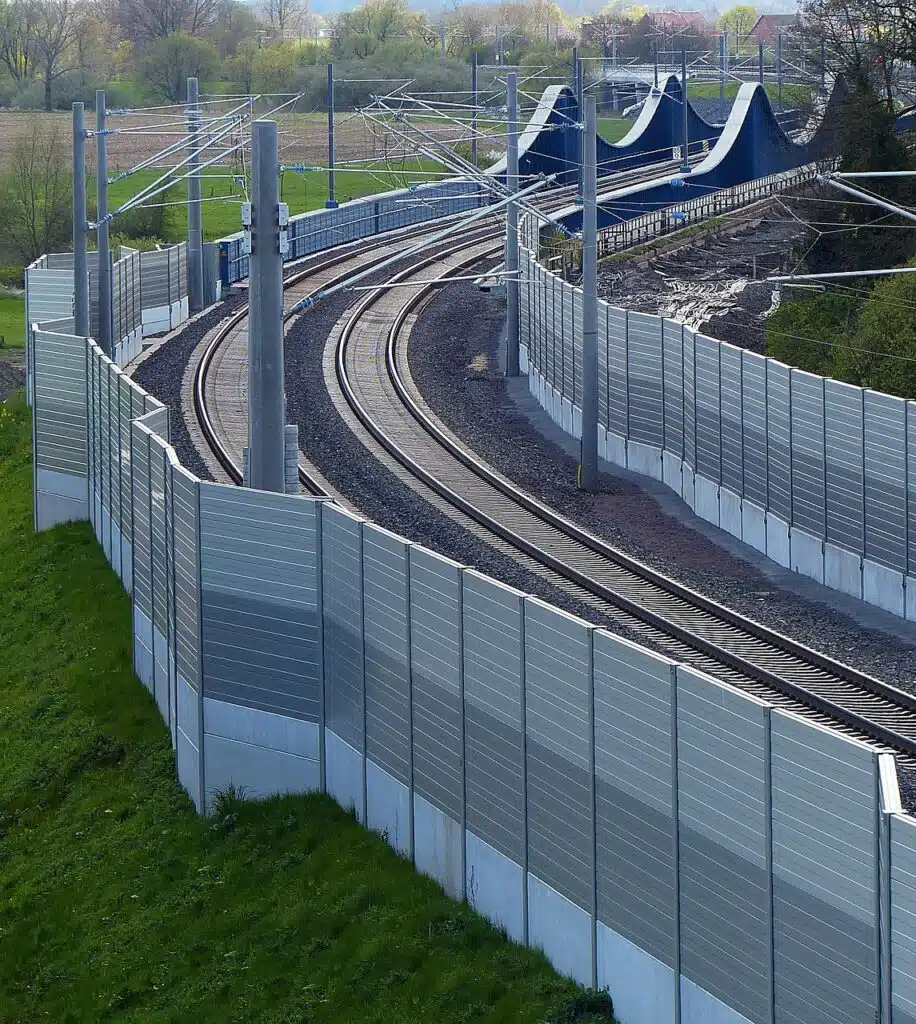
Barrier attenuation involves placing a solid or absorptive obstacle between a noise source and receiver to physically block or diffract sound. Barrier attenuation is also defined, mathematically, within ISO 9613-2:2024.
It’s one of the most practical mitigation techniques in environmental noise control, often used to protect dwellings or public spaces from road traffic, railways, or fixed plant.
At Polaris Acoustics, we regularly conduct noise assessments and surveys for schemes which require us to advise on the specification of an acoustic barrier, to ensure optimal noise control and to help manage costs associated with the implementation of an acoustic barrier. This has helped to secure planning permission for many new residential schemes that we have worked on.
How Acoustic Barriers Work
A noise barrier works by:
- Interrupting the line of sight between source and receiver.
- Forcing sound to diffract over or around the top edge.
- Absorbing or reflecting sound energy depending on surface design.
The resulting insertion loss (noise reduction) typically ranges between 5–15 dB(A), depending on geometry, height, and frequency content. This can be greater, and has the potential to exceed a sound reduction of 20 dB or more under ISO 9613 predictions and based on field testing data.
Noise Barrier Types
- Solid Barriers: Concrete, metal, or timber walls used along roads and plant compounds.
- Absorptive Barriers: With mineral wool or perforated facings to reduce reflections.
- Transparent Barriers: Acrylic or laminated glass maintaining visibility without sacrificing attenuation.
- Vegetated or Earth Berms: Offer aesthetic and ecological value alongside acoustic screening.
Design Factors for Noise Barriers
- Height and Position: Must break line of sight between source and receptor.
- Continuity: Gaps or flanking paths can nullify performance.
- Surface Type: Absorptive barriers prevent unwanted reflection toward other façades.
- Material Mass: Typically >10 kg/m² for effective low-frequency control.
Example:
At a mixed-use development in Hackney, London, a 2.4 m high absorptive steel barrier around rooftop condensers reduced the predicted façade noise from 54 dB LAeq,T to 42 dB LAeq,T at the nearest flat — enough to meet BS 4142 criteria and discharge a planning condition.
Relevant Standards
- BS 4142:2014 + A1:2019 – Assessment of industrial and commercial sound.
- BS 5228-1:2009 + A2:2018 – Construction noise control.
- CRTN and DMRB LA 111 – Predict attenuation from road barriers.
- ISO 9613-2 – Used for modelling environmental attenuation in noise mapping.
5. Integrating Acoustic Controls in Practice
Most real-world designs use a combination of controls. The right blend depends on the noise path — source, transmission route, and receiver.
| Scenario | Primary Acoustic Controls | Purpose / Outcome |
|---|---|---|
| Heat Pump near Flats | Isolation + Barrier Attenuation + Absorption | Complies with BS 4142 rating level limits |
| Plant Room Adjacent to Offices | Absorption + Isolation | Reduces reverberant noise and breakout |
| Residential Development near Road | Barrier Attenuation + Isolation | Meets BS 8233 external façade criteria |
| Open-Plan Office | Absorption + Diffusion | Improves speech clarity and privacy |
| Construction Site | Barrier Attenuation + Absorption | Reduces on-site activity noise (BS 5228 compliance) |
Early Design Integration
Acoustical control is most effective — and most economical — when integrated before planning submission.
An Environmental Noise Assessment or Noise Impact Assessment can identify where barriers, absorptive linings, or isolation measures will be needed. Early collaboration prevents delays in discharging planning conditions later.
If you feel like you might need to consider how noise affects your development, and how to ensure your scheme sails through the planning process, get in touch today for a free quotation.
6. UK Policy and Regulatory Context
Planning and Environmental Noise Control
Under the NPPF and NPSE, local authorities must ensure that development avoids “significant adverse effects” from noise and mitigates where necessary.
Professional Frameworks
- ProPG: Planning & Noise (2017) – Sets out a risk-based approach for new residential development near transport noise.
- BS 8233:2014 – Provides internal and external design targets for dwellings and offices.
- BS 4142:2014 + A1:2019 – Used to assess and rate sound from fixed plant or industrial sources.
- BS 5228-1 – Governs construction noise and the role of barriers and enclosures.
Building Performance
Inside buildings, Part E of the Building Regulations** and guidance like CIBSE Guide B5 or HTM 08-01 set minimum standards for airborne, impact, and reverberant noise control.
7. Emerging Trends and Best Practice
Hybrid Acoustic Systems
Many developments now combine multiple control types — e.g. acoustic louvres (absorption + isolation) or green façades (diffusion + barrier function). The latter incorporating principles of psycho-acoustic design, which can help to reduce the perceived level of noise.
Digital Acoustic Simulation
Predictive tools (e.g. CadnaA, iNoise, Odeon) allow consultants to visualise noise propagation, façade reflection, and barrier effectiveness before construction begins.
Sustainability & ESG Alignment
Acoustic comfort supports wellbeing and sustainability objectives under BREEAM Hea 05 and the WELL Building Standard, linking good design with occupant health and long-term social value.
FAQs
1. What’s the difference between environmental and building acoustics?
Environmental acoustics deals with noise in the open environment (roads, plant, rail), while building acoustics focuses on sound behaviour within and between spaces inside a structure.
2. Can absorption and barriers be used together?
Yes. Many barriers now include absorptive linings to reduce reflected sound — particularly effective for plant compounds and urban courtyards.
3. Do all developments need acoustic control?
If noise could affect neighbouring properties or internal comfort, yes. Planning authorities often condition assessments under BS 8233 or BS 4142 to prove adequate mitigation.
4. How much attenuation can a barrier achieve?
Typically 5–15 dB(A), depending on height, frequency range, and geometry. More complex layouts may require enclosure or isolation measures for higher reductions.
5. Is acoustic control part of sustainability design?
Absolutely — controlling noise contributes directly to occupant health, productivity, and ESG compliance.
Conclusion
Effective acoustical control brings together science, regulation, and design sensitivity.
Whether reducing environmental noise from transport or internal noise from plant, combining the four key strategies — absorption, diffusion, isolation, and barrier attenuation — allows buildings and developments to meet UK planning, comfort, and sustainability standards.
At Polaris Acoustics, we specialise in designing and assessing these measures as part of Noise Impact Assessments, BS 8233 façade design, BS 4142 plant assessments, and construction noise management plans.
If your project involves noise-sensitive development or fixed plant, we can help you specify the right balance of controls for a quieter, compliant environment.