

A noise survey report should explain what was measured, whether those measurements represent the site and what they mean for the proposed development. The important part is how the evidence supports a design or planning decision.
If you have been asked to submit a report, first check what question the council wants answered. New homes beside a road, a restaurant extraction system and outdoor sports facilities need different assessments. A report prepared for one purpose may not answer another.
This guide explains when a noise survey is needed, how the work is carried out and how the resulting report informs design and supports a planning submission.
When a Noise Survey Report is Required
A council may request a noise survey for planning where new homes would be exposed to traffic or other environmental noise, or where a proposed activity could affect neighbours. It may be needed with a planning application or to address a specific condition on an existing permission.
Check the council’s validation requirements and any advice from its environmental health officer. If a condition has already been issued, send the full wording to the consultant. An assessment of the site’s suitability for housing will not necessarily satisfy a later requirement to specify ventilation or verify installed plant.
The scope should identify the development, relevant noise sources, affected locations and the decision the evidence needs to support. That brief determines the noise survey report requirements.
What Happens During an Acoustic Survey
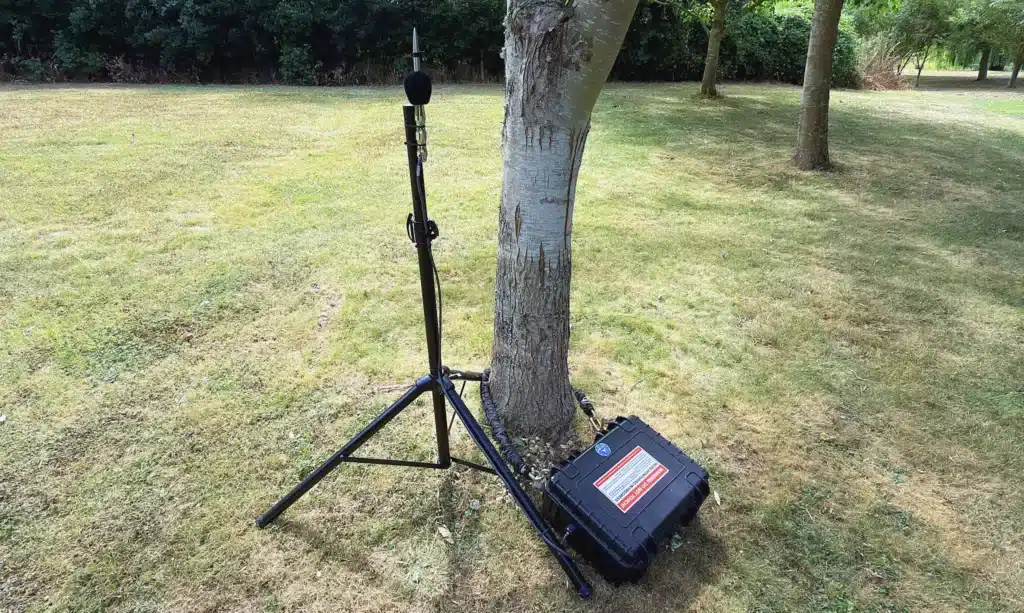
An acoustic survey, also called a noise survey, starts with a brief: the proposed development, the sounds of interest and the locations where their effects matter. The consultant reviews the plans and council requirements before deciding where and when to measure.
On site, suitable calibrated sound level equipment is positioned to capture representative conditions. Field calibration checks, photographs, weather information and observations provide a record of how the measurements were obtained. Attended observations can help identify sounds that an unattended logger records without explaining their source.
The data is then checked for unsuitable periods and interpreted for the agreed assessment. The acoustic survey requirements should follow the planning question. A fixed number of monitoring days or an equipment specification alone cannot establish that the survey answers it. The data will then be presented within the noise survey report.
A Survey and an Assessment Do Different Jobs
An acoustic survey measures the sound environment during the monitoring period. An assessment interprets that evidence against the proposal, relevant guidance and planning context. A noise survey report for planning will often contain both.
For housing, measured external levels may inform the layout and the required performance of windows and ventilation. For proposed plant, the existing background measurements help assess a separate prediction of sound from equipment that has not yet been installed.
The noise survey report should connect those steps explicitly. A table of measurements from an empty site cannot, by itself, demonstrate the effect of a future noise source. For the structure and supporting documents expected in a submission, see our guide to noise impact assessment report contents.
What the Main Noise Measurements Mean
The letters after a decibel value describe what has been measured. Two figures with different descriptors may describe different aspects of the same sound environment.
LAeq,T is the equivalent continuous sound level over a stated period, T. It represents the sound energy of a changing signal as an equivalent steady level. It is commonly described as an average, although it is not a simple arithmetic average of decibel readings.
LA90,T is the level exceeded for 90 per cent of the stated period. It is commonly used to describe background sound. Selecting a representative background for an assessment requires consideration of the data and the relevant operating periods; the lowest recorded value is not automatically the right choice.
LAFmax describes the highest A-weighted sound level during the measurement interval using Fast time weighting. It can help describe events such as a vehicle passing or a door closing. Understanding the source and how often events occur matters as well as their individual maximum levels.
The ‘A’ refers to A-weighting, which adjusts the contribution of different frequencies to broadly reflect human hearing sensitivity. It is widely used in environmental noise assessments, although perceived disturbance also depends on factors such as sound character, timing and context. Frequency-band data may be needed where the assessment or design requires more detail than a single overall level.
Read the Measurement Period with the Number

A result of 60 dB LAeq over 15 minutes is not interchangeable with 60 dB LAeq over a whole night. The longer period may include quiet intervals that change the average. The relevant assessment period depends on the source, the guidance being applied and the planning question.
For an illustrative example, a site could have steady traffic for part of the night and occasional louder vehicle passages. An average level alone would not describe those individual events. The report should explain which results inform the assessment of bedrooms and why.
When comparing results between reports, check the time period, measurement position and conditions. Matching decibel numbers do not necessarily mean the evidence is equivalent. Polaris Acoustics uses Class 1 sound level equipment, supported by calibration checks and documented survey conditions, to obtain measurements suitable for the assessment.
Check Where and When the Acoustic Survey Took Place
The monitoring plan should represent the locations and conditions relevant to the development. A microphone near a busy road may be suitable for the exposed façade of a proposed building. It may say little about a screened courtyard on the opposite side without further interpretation.
Measurements close to a reflecting façade can differ from measurements away from reflecting surfaces. The report should identify the measurement conditions and explain any corrections used. Otherwise, a comparison between a façade measurement and a free-field prediction can be misleading.
Dates, weather and site observations also matter. Strong wind or rain can affect the data, while a road closure, school holiday or inactive neighbouring business may make an acoustic survey less representative of the conditions the development will experience.
There is no single monitoring duration suitable for every site. The survey needs to capture the variation relevant to the assessment. That may require weekday and weekend coverage, evening observations or measurements during a particular activity. Extra days are useful when they answer an identified uncertainty.
How the Acoustic Survey Results Inform Design

For homes, BS 8233 provides guidance relevant to noise within buildings and external amenity. Its application needs to consider the actual rooms, external sound and proposed construction.
A window’s laboratory sound insulation rating is not simply a figure to subtract from the measured external level. The performance of the whole façade depends on the window area, surrounding wall, vents, room characteristics and the noise spectrum. The report should turn the assessment into a specification the designer and supplier can use.
Ventilation and overheating also need attention. If the acoustic assessment assumes windows are closed, the design team must explain how the building will be ventilated and how overheating will be addressed in that condition. Mechanical ventilation does not automatically provide cooling, and a summer bypass on a ventilation system is not proof that the overheating strategy works.
Layout can sometimes reduce the need for more demanding façade specifications. Moving a bedroom to a quieter side or screening an outdoor space may be worth testing before individual products are selected. Our BS 8233 assessment service covers the survey and design questions involved.
Reading a Plant Noise Assessment
In an assessment of industrial or commercial sound under BS 4142, the proposed or measured source contribution is considered separately from the existing sound environment. Adjustments may be needed for relevant characteristics of the source, such as a noticeable tone or impulsive sound, to establish its rating level.
The comparison with a representative background level informs the assessment, together with context and uncertainty. It should not be reduced to an unexplained pass or fail based on one subtraction. The report needs to identify the equipment, operating assumptions and assessment positions so the conclusion can be checked.
Manufacturer data also needs to be used correctly. A sound power level describes the source’s sound emission, while a sound pressure level applies at a measurement position under stated conditions. They are not interchangeable. For more on the approach, see our plant noise assessment service.
Acoustic Modelling
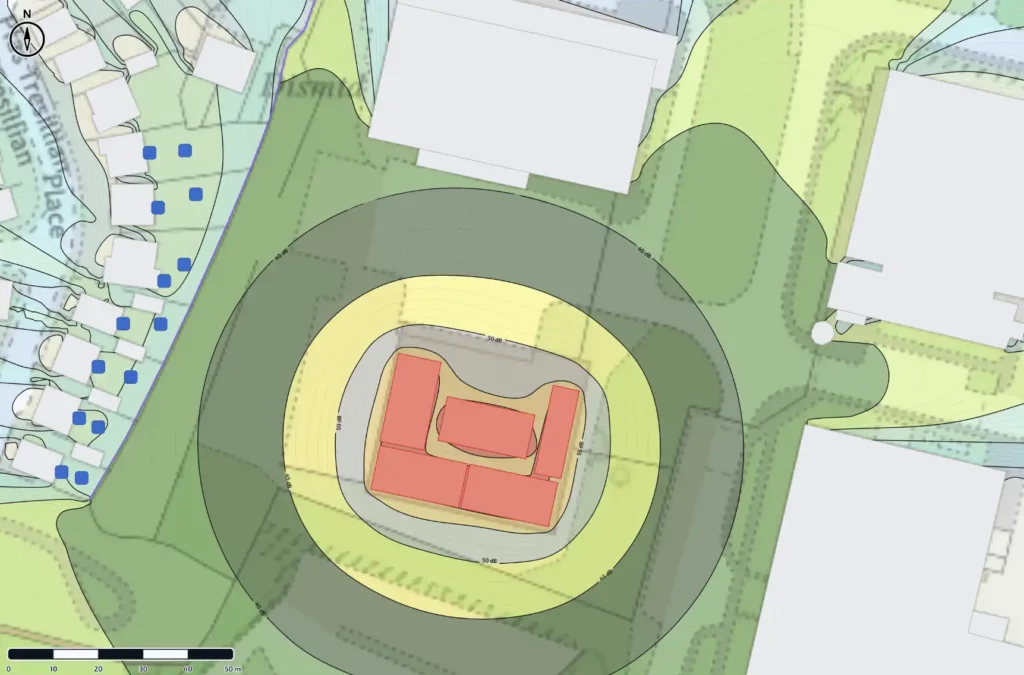
Acoustic modelling can form an important part of a noise survey report or noise impact assessment, particularly where a development has not yet been built or different design options need to be compared. Specialist noise mapping software, such as AURIS, helps predict how sound travels across a site, accounting for noise source positions, buildings, ground levels, reflections and acoustic barriers. Results can be presented as coloured noise contours alongside predictions at specific noise-sensitive locations, such as gardens and bedroom windows. For residential noise assessments, this helps identify more exposed façades and quieter outdoor spaces. For plant noise assessments, it helps establish how proposed equipment could affect neighbouring properties.
The prediction method should suit the noise source and assessment. ISO 9613-2:2024 provides an engineering method for calculating outdoor sound propagation, including the effects of distance, atmospheric absorption, ground conditions, reflections and screening. It predicts levels under weather conditions favourable to sound propagation and also provides for calculating long-term average levels using a meteorological correction. Road traffic noise can be assessed using Calculation of Road Traffic Noise (CRTN 1988), which considers traffic flows, speeds, heavy vehicle proportions, road surfaces and site geometry. CRTN predicts LA10 indices, so assessments requiring daytime or night-time LAeq levels need an appropriate, justified conversion or supporting measurements. The report should clearly identify the method, source data and assumptions used.
Modelling also allows noise mitigation measures to be tested before construction, including changes to site layouts, equipment positions, acoustic enclosures and barrier heights. A barrier’s predicted benefit depends on its position, length and height relative to the source and receiver, together with its construction and any gaps. A barrier protecting a garden may provide less screening to an upper-floor window. Noise maps should therefore state their calculation height, assessment period and noise descriptor, with numerical results provided at relevant assessment positions. Comparing consistent scenarios helps establish practical mitigation requirements, while reviewing uncertain inputs helps determine how reliable the conclusions are.
What to Check Before a Planning Submission
Read the conclusions of the noise survey report alongside the drawings. Check that the assessed layout matches the submission and that any recommended measures appear in the design or operating proposals.
In particular, look for:
- A clear explanation of the acoustic survey’s purpose and the conditions it represents.
- Assessment positions relevant to the people or spaces affected.
- Justified source and operating assumptions for proposed activities or plant.
- Mitigation that can be specified and built, with predicted results after it is applied.
- Remaining uncertainties and any verification needed after installation.
If the report relies on a barrier, its height and extent need to agree with the drawings. If it relies on restricted hours, those hours need to match the intended operation. A recommendation that remains only in the acoustic report can be missed during construction or procurement.
Cost, Timing and Existing Survey Data
The scope of the noise survey report determines the fee and programme. Relevant factors include the number of monitoring positions, access, variation in the noise sources, prediction work and the level of design advice required. Our noise assessment cost guide explains the main cost factors; a site-specific scope is needed for a quotation.
Existing measurements may be useful where their purpose, locations and conditions remain relevant. Age alone does not establish whether they are suitable. Changes in traffic, neighbouring activities or the development design may require further work even where a noise survey is relatively recent.
A noise survey report provides defensible and robust evidence for a decision. It does not guarantee planning permission or replace other conditions attached to a consent. If the council has requested an acoustic report, send its exact wording at the outset to your acoustic consultant so that the scope of work addresses the requirement.
Contact Polaris Acoustics with your site address, proposed plans and any council correspondence. We can review what the assessment needs to demonstrate and advise whether existing survey information can contribute and provide a no-obligation quotation.
Frequently Asked Questions about Noise Survey Reports
-
Do I need a noise survey report for planning permission?
You may need one where a development introduces noise near neighbouring properties or places new homes beside existing noise sources. Check the council’s planning application requirements and any environmental health comments. If permission has already been granted, the wording of a noise condition will determine what evidence is needed.
-
What is the difference between a noise survey and a noise assessment?
A noise survey measures sound under recorded site conditions. A noise assessment interprets those measurements and considers the proposed development. For example, assessing new extraction equipment usually involves predicting its contribution at neighbouring homes as well as measuring the existing sound environment.
-
How much does a noise survey report cost?
The fee depends on the monitoring required, site access, the sources being assessed and whether modelling or mitigation design is needed. Providing the site plans and council requirements helps us define the work and give a quotation. Our noise assessment cost guide explains the main factors.
-
How long does a noise survey take?
The monitoring period needs to represent the conditions relevant to the assessment. Some projects require daytime and overnight measurements; others need weekday and weekend coverage or observations during a particular activity. The consultant should explain the proposed duration and why it is suitable for your site.
-
How soon will I receive the noise survey report?
The programme should be agreed when the work is commissioned. Reporting follows the survey, data checks and assessment, and may require equipment specifications or updated drawings from the design team. Providing this information early helps avoid delays, particularly where mitigation options need to be tested.
-
Can an existing noise survey be reused?
Potentially, provided its measurement locations, methods and conditions remain relevant. There is no single expiry period suitable for every survey. Changes to traffic, neighbouring activities or the proposed development may require additional measurements. The consultant should review the original report before relying on it.
-
Does a noise survey report mean windows must remain closed?
That depends on the external noise and the building design. Where closed windows are needed to achieve the assessed internal conditions, ventilation and overheating must also be addressed. The report should explain these assumptions so the architect can coordinate the acoustic advice with the wider design.
-
Can the noise survey report help discharge a noise planning condition?
Yes, where it addresses the condition’s specific requirements. Some conditions require an assessment and mitigation proposals; others require evidence that installed measures achieve a stated performance. Send the complete condition wording before commissioning the work so the scope covers the evidence the council needs.


