A padel court noise assessment should establish whether a proposed venue can operate without an unacceptable effect on its neighbours, what evidence the council needs and which design decisions matter. That is useful information before signing a lease, ordering courts or submitting a planning application.
Outdoor courts, tennis court conversions and indoor warehouse venues need different approaches. This guide explains the acoustic considerations behind padel court planning permission, how to assess individual impacts and when new noise monitoring may be unnecessary. It also looks at padel court noise mitigation, drawing on our own assessment work.
Before committing to a site:
Check average activity noise and individual impacts separately. Investigate nearby gardens and bedroom windows, including upper floors. For indoor venues, establish how the building will be ventilated with large doors closed. A noise assessment may be possible without new baseline monitoring, but only where the evidence and assessment requirements support that approach.
1. Padel Court Planning Permission: What Should Be Assessed?
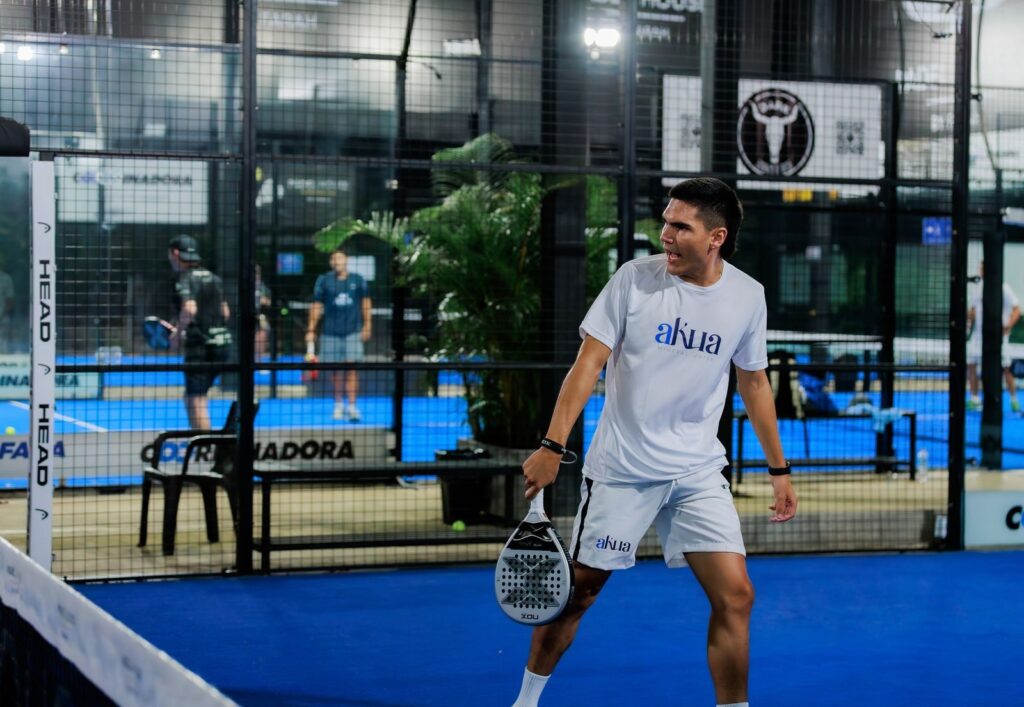
The LTA’s court guidance advises that constructing a padel court, including over an existing tennis court, requires planning consent. It specifically identifies noise affecting neighbouring residential properties as a site-selection consideration. Confirm the position for the particular proposal with your planning adviser or local planning authority.
An existing sports use is relevant context, but does not establish that padel will have an equivalent effect. A tennis court or multi-use games area conversion should be considered against the existing activity, proposed court numbers, booking intensity, hours and enclosure design.
The June 2026 draft ProPG: Guidance for the Assessment of Sport and Leisure Noise identifies a new noise-generating activity, longer hours and intensified use as reasons an assessment may be needed. These are more useful questions than simply asking whether the land is already used for sport.
Check the Operation, Not Just the Drawings
For padel court planning permission, the submitted scheme and acoustic assumptions need to agree. Establish the busiest credible period, whether several courts will operate together, and whether coaching, spectators, outdoor seating, music or mechanical services form part of the proposal.
The final booking is not necessarily the end of activity. Customer departures, servicing and ventilation may continue afterwards. Those arrangements should be identified before the report is completed.
A padel court noise assessment addresses one part of the application. Lighting, transport, access, drainage and other matters still need appropriate consideration. Acoustic screens and building alterations should also be coordinated with the planning drawings and structural design.
Our noise impact assessment for planning service explains how acoustic evidence can support the submission.
2. Why Maximum Noise Events Matter Alongside the Average
Padel generates sound from racket and ball contact, impacts against the court enclosure and player voices. The draft Sport and Leisure ProPG identifies padel impacts as events requiring consideration alongside average noise.
Two measures describe different aspects of that activity. LAeq,T represents the energy-average sound level over a stated period. LAFmax describes the maximum A-weighted sound level using Fast time weighting. A lower hourly average does not necessarily mean that individual strikes will be inconspicuous.
A useful padel court noise assessment therefore examines the level and recurrence of representative impacts, as well as the combined activity over a busy period. It should identify what produced the maximum events, which source evidence was used and how the predictions relate to neighbouring properties.
How Loud is a Padel Court?
There is no single source level that describes every court and game. In one of our assessments, the principal published source dataset provided approximately 52 dB LAeq and 81 dB LAFmax at 5 metres to the side of a court. Those source measurements were reported by Clarke Saunders Acoustics, not measured by Polaris for that project.
The June 2026 draft ProPG also contains padel measurements. Its examples include average levels of approximately 60 dB LAeq,30min at the stated side-of-court positions, with lower averages at the positions behind the rebound wall. The measurement positions, games and periods matter; these are not interchangeable universal values.
We tested the higher average source assumption in the project described below. That sensitivity check was important because it showed whether the conclusion depended on choosing the lower dataset.
For padel court noise mitigation, the distinction between average noise and individual events also matters. Shorter hours can reduce exposure but do not make each strike quieter. More occupied courts can increase average activity without justifying an assumption that every court produces its loudest impact at exactly the same instant.
3. What Does the Draft Sport and Leisure ProPG Say?
The June 2026 consultation draft was prepared by a working group involving the ANC, IOA and CIEH. It sets out a staged approach: good acoustic design, initial noise screening and, where necessary, a detailed assessment. It also includes measured sports source data, with examples for padel.
For developers, the potential benefit is greater consistency in how consultants scope an assessment, select source information and explain their conclusions. That could help identify constraints before a layout or lease becomes difficult to change.
Which Noise Levels Are Relevant?
For average sports activity, the draft proposes 50 dB LAeq,T as a generally applicable criterion for the enjoyment of external spaces, with a one-hour assessment period recommended in most cases. It recognises that the criterion or assessment period may require adjustment.
For frequently occurring impulsive or short-duration events, it proposes 65 dB LAFmax as a general starting point, again subject to context. This is not a statutory padel noise limit, a guarantee against disturbance or an automatic test for every operating hour.
Early-morning use needs particular care. A 06:00 opening falls within the 23:00–07:00 night-time period discussed in the draft. Daytime external-amenity criteria should not simply be applied across the whole operating day without considering sleep and the relevant receptor conditions.
Sport England’s Artificial Grass Pitch Acoustics guidance is another relevant reference, but it was written for artificial grass pitches rather than padel. Its use as supporting guidance should be explained, not presented as a padel-specific standard.
Understand the Scope Before Applying the Guidance
The draft’s stated scope concerns outdoor sport and leisure activity. Applying relevant assessment principles to sound escaping from an indoor venue requires an explanation; it does not replace an assessment of the building itself.
It also excludes ancillary sources such as fixed plant, music, catering, crowds and parking from its scope. These may need separate consideration. For example, ventilation and air-conditioning equipment may require a BS 4142 plant noise assessment. Recreational play should not automatically be treated as industrial sound simply because the venue is a commercial business.
This section describes the June 2026 consultation draft. A project report should identify the applicable guidance and edition, explain any use of draft recommendations and address the relevant planning framework and local requirements.
4. Does a Padel Venue Need a New Baseline Noise Survey?
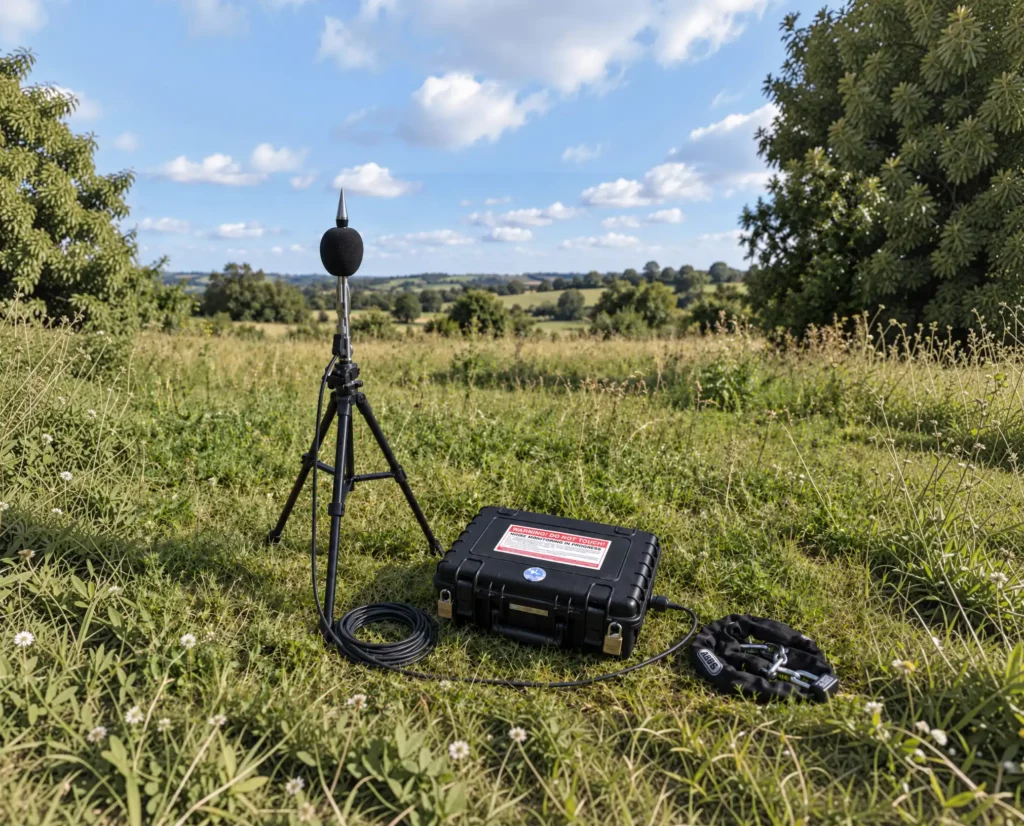
Not always. A noise assessment and a new baseline survey are different things. The draft ProPG expressly leaves the need for a baseline survey at the initial screening stage to professional judgement, taking account of the proposal, receptors, other sources and separation distances.
A padel court noise assessment may be possible without new environmental monitoring where reliable evidence and suitably cautious predictions support the conclusion. A fully enclosed venue with sufficient separation can be a candidate for that approach, but being indoors is not itself an exemption.
The important question is whether the conclusion depends on an unmeasured existing sound level. Where it does, appropriate representative evidence is needed. Predictions must also account for relevant maximum events, operating hours, doors, ventilation and other sources.
What Would Make a Desktop Assessment Defensible?
We would examine the source evidence, building information, nearby sensitive uses and reasonable uncertainty. A favourable result based on an optimistic wall specification or an assumed background level is not enough.
A sensitivity test can be particularly useful. Would the conclusion still hold with a higher source level or reduced credit for enclosure? The first project example below illustrates that reasoning.
Historic measurements may provide context, but should not be presented as current conditions without justification. Likewise, a desktop environmental assessment may still require a building inspection or other investigations.
What if Environmental Health Has Requested Monitoring?
Check the planning condition, validation requirements and council correspondence. Where monitoring has been expressly requested, discuss and document any proposed alternative scope before omitting it.
Our guidance on baseline noise measurements explains why measurement location and period matter. A busy daytime survey should not automatically stand in for the quieter opening or closing hours.
5. What Our Padel Court Noise Assessment Work Has Shown
The following examples are drawn from Polaris Acoustics project reports. Names and identifying details have been omitted, distances are presented as approximate ranges and results are rounded. The figures are predictions for the assessed proposals, not post-opening measurements or claims of planning approval.
An Indoor Venue Where the Conclusion Did Not Rely on Warehouse Containment
For a proposed multi-court warehouse venue, the closest assessed gardens and residential façade were approximately 50–60 metres from the nearest court. We assessed simultaneous activity across the proposed courts and considered maximum impacts separately.
The highest predicted average was approximately 33 dB LAeq,1h without credit for sound containment by the warehouse. Repeating the average-noise assessment with the higher source assumption from the draft ProPG increased the result to approximately 41 dB LAeq,1h. Both were below the 50 dB reference used in the report.
The maximum-event calculation gave approximately 61 dB LAFmax before credit for the warehouse, the existing bund and barrier, or other propagation reductions beyond distance spreading. This had a smaller margin against the report’s adopted maximum-event reference than the principal average-noise result.
The assessment did not rely on new baseline monitoring. Historic information for neighbouring housing was considered as context, not substituted for a contemporary survey. The report also retained specified building and operational controls.
The useful lesson: the desktop approach was supported by the assessment evidence and sensitivity testing, not by a general assertion that warehouses are quiet. The average and maximum-event results had different margins, so both needed explaining.
An Indoor Venue Where Building Containment was Essential to the Assessment
At another proposed indoor venue, the closest assessed homes were approximately 20–30 metres from the nearest court. Here, the building was an important part of the assessment rather than an additional precaution.
The report applied a 15 dB overall building-containment allowance, conditional on large external doors and other significant openings remaining closed during play. With that assumption, the highest predicted levels were approximately 30 dB LAeq,1h and 54 dB LAFmax.
Without the allowance, the corresponding maximum-event prediction was approximately 69 dB LAFmax. These were modelled scenarios, not measurements demonstrating that every comparable building achieves the same reduction. Baseline monitoring provided additional site-specific context in this assessment.
The useful lesson: a short separation distance does not answer the planning question by itself. The design and operation of the building mattered, and the acoustic conclusion could not simply be transferred to an outdoor court or a venue operated with its large doors open.
Together, these examples show why padel court noise mitigation should follow the assessment findings rather than a generic package of products or standard separation distances.
6. Padel Court Noise Mitigation: Indoor and Outdoor options
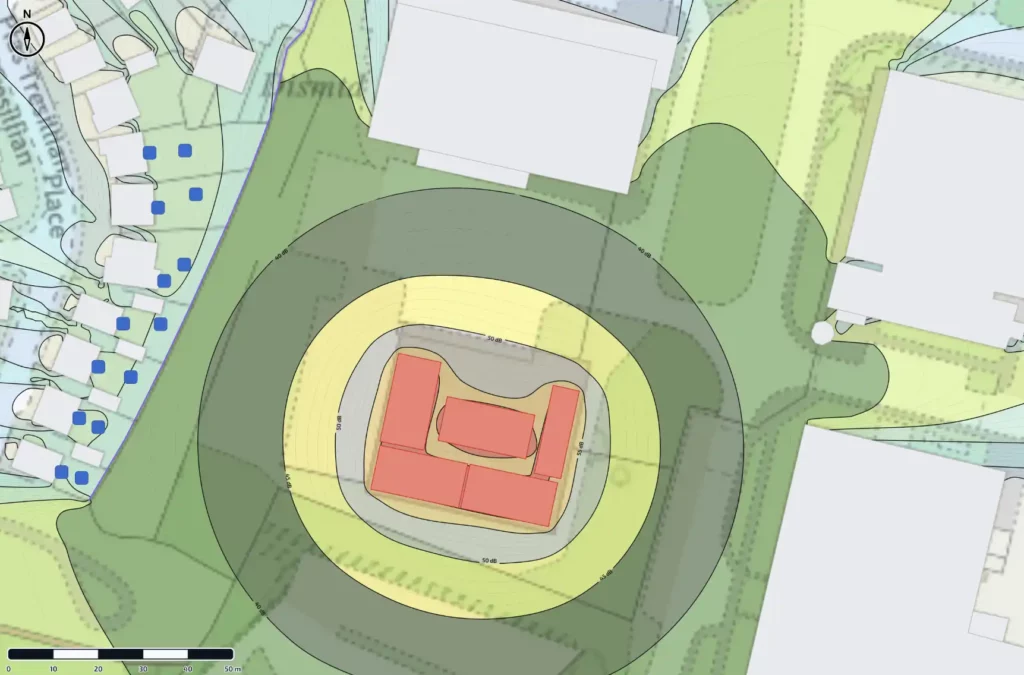
Indoor Venues: Check the Whole Sound Path
For indoor padel court noise mitigation, the noise impact assessment should connect the sound generated inside of the building envelope with transmission through the walls, roof, glazing, doors and ventilation openings. Internal absorption and external sound insulation address different parts of that process.
In the first example, sound-absorptive curtains were included in the proposal, but the predictions took no numerical benefit from them. They were additional treatment, not a reduction on which the assessment conclusion depended.
For another venue, treatment or construction upgrades may be essential. We would establish the required performance and how it will be delivered rather than apply a standard “warehouse reduction” without a project-specific basis.
Before committing to a lease, resolve ventilation and access. Where the assessment requires large doors to remain closed during play, the venue needs a workable arrangement for busy summer sessions. Adjoining occupiers and shared construction may also need investigation.
Outdoor Courts: Test Layout and Screening Together
For outdoor padel court noise mitigation, our starting point is the court layout and relationship with nearby receptors. Compare positions, separation, ground levels and potential screening before selecting a barrier product.
ISO 9613-2:2024 provides an engineering method for predicting outdoor sound propagation. It does not provide a planning acceptance limit. The model still needs suitable source information, credible operating scenarios and assessment locations that represent the affected properties.
A barrier design should identify its height, position, length, construction and openings. Check upper-floor windows as well as gardens. The benefit needs to be demonstrated at those locations, not inferred from the product name or a plan showing a solid line.
Court orientation can be investigated, but a difference between two measurement positions should not be assumed to be a guaranteed reduction for every court and game. Similarly, evidence for quieter mesh or resilient fixings needs to identify which source was reduced; it should not automatically be applied to racket impacts or voices.
Make Operational Controls Realistic
Hours, door management, amplified sound and customer activity may form part of padel court noise mitigation. Those commitments should be written clearly and reflected in the operating plan.
When reviewing padel court planning permission, distinguish proposed padel court noise assessment recommendations from conditions actually imposed by the council. A noise management plan is useful for implementing controls, but should not be used to disguise a physical design that fails to address normal play.
Discuss your proposed layout and acoustic requirements before committing to a particular screening or building-treatment package.
7. How Much Does a Padel Court Noise Assessment Cost?
The fee depends on the work required. A focused desktop appraisal, a survey-led planning padel court noise assessment and a detailed building-breakout assessment are different scopes. The number of courts alone is not a reliable pricing basis.
For a quotation, send the site address, court layout, proposed hours and any planning or Environmental Health comments. For an indoor proposal, include available construction information and the intended arrangements for doors and ventilation.
The quotation should make clear whether it includes monitoring, average and maximum-event predictions, plant assessment, mitigation design and responses to council comments. Our wider guide to noise assessment costs explains the factors involved.
Tell us the submission or determination deadline at the outset. Distinguish the time needed to arrange monitoring from the reporting period after measurements and the necessary information are available. Where mitigation changes are likely, allow time to revise the plans as well as the report.
Questions Typically Asked Before Committing to a Site
How far should padel courts be from houses?
There is no universally applicable acoustic separation distance for padel courts or similar MUGA pitches. Our examples illustrate proposals with different distances and different assessment dependencies; neither establishes an acceptable distance for another site. Outdoor screening, upper-floor exposure, source levels, hours and local context can all affect the assessment.
Is a canopy the same as an indoor venue?
No. Assess the actual enclosure and sound paths. The LTA describes covered structures with different roof and side arrangements; a weather canopy should not automatically be credited with the containment of a fully enclosed building.
Can we convert tennis courts or a MUGA without changing opening hours?
Unchanged hours do not settle the acoustic question. Review the new activity, intensity of use, enclosures and neighbouring receptors. The scope of padel court planning permission and any existing restrictions should also be checked for the particular site.
Does a favourable noise report guarantee permission?
No. The planning authority considers the whole application and may disagree with aspects of the evidence. England’s planning practice guidance on noise also explains that planning permission does not prevent a separate statutory nuisance investigation. A defensible padel court noise assessment supports the planning judgement; it does not guarantee approval or prevent complaints.
Discuss Your Padel Proposal
Polaris Acoustics can review the acoustic requirements for new sports courts, existing sports-site conversions and indoor venues. We will advise on the appropriate survey and assessment scope and investigate mitigation where required.
For a padel court noise assessment quotation, send the site address, proposed layout, operating hours and any council comments. You do not need a completed design before contacting us.
Get a quote for your padel project
Technical References
ANC, IOA and CIEH, ProPG: Guidance for the Assessment of Sport and Leisure Noise, June 2026 consultation draft, particularly sections 4, 8, 9, 11 and the padel source-data examples in section 13. The discussion above refers to that draft edition and does not present its recommendations as statutory limits.
Source measurements attributed to Clarke Saunders Acoustics are reported as such in the underlying Polaris project assessment. Project examples describe the scope and predictions in those reports; they are not universal design specifications.