
Services · Heat pump noise assessments
Air source heat pump noise assessments for homes and commercial buildings, from MCS 020(a) checks to BS 4142 reports for planning.
Mathew Vaughan MSc MIOA checks whether your installation can rely on permitted development. Where it cannot, he measures the background sound, predicts the level at neighbouring homes and sets out clear limits and mitigation, following BS 4142:2014+A1:2019.
MIOA acoustic consultant · Class 1 instrumentation · Fixed-fee quotes · Survey dates confirmed with your quote
At a glance
Standards
MCS 020(a), BS 4142:2014+A1:2019
Typical survey
24 hours to several days
Deliverable
MCS check or noise report
Consultant
Mathew Vaughan MSc MIOA
LA90
Background sound level measured at the nearest homes
+10 dB
Rating around 10 dB above background: likely significant adverse impact
+5 dB
Rating around 5 dB above background: likely adverse impact
≤ 0 dB
Rating at or below background: low impact
Initial estimates from BS 4142:2014+A1:2019 section 11. All depend on context. MCS 020(a) is a separate calculation used for permitted development.
When you need one
Many domestic installations rely on permitted development, which in England includes meeting MCS 020(a). An assessment is needed when an installation does not qualify, or when the council asks for more than an MCS check.
Installations that do not qualify, for example because of the unit’s position, the property’s listed status or local restrictions.
Applications where the council asks for a noise assessment to BS 4142 before it decides.
Larger installations, where BS 4142 applies more often than the MCS method.
A heat pump noise condition to discharge, or an Environmental Health enquiry about an existing unit.
Already received a planning condition or an Environmental Health request for a heat pump noise assessment?
Get a fixed-fee quoteWhat’s included
MCS 020(a) is a calculation method, not a product test. It uses the manufacturer’s declared sound data to predict the level at the assessment position, 1 m from the centre of any door or window to a habitable room of a neighbouring property. The limit is 37 dB(A). MCS 020(a) has been the named standard for permitted development in England since 29 May 2025. Scotland, Wales and Northern Ireland stay on MCS 020, which has a 42 dB(A) limit, and their own rules.
BS 4142 compares the rating level, which is the specific sound level from the unit plus any character corrections, with the background sound level. The result is then weighed against the context of the site.

Heat pump guide
Air Source Heat Pump Noise: MCS Limits and Planning Rules
Read the guide →
Permitted development check
We review the unit, its position and the permitted development conditions. In England these include MCS 020(a), up to two units on a detached house and a volume limit of 1.5 m³ for a dwellinghouse.
Output: whether permitted development is available
MCS 020(a) calculation
The level at the assessment position is calculated from the manufacturer’s declared sound data, using the MCS method.
Output: calculated level at the assessment position
Background sound survey
Measurement of the LA90 background sound level over the hours the heat pump will run, including the quietest night-time periods.
Output: representative background level
Rating level
The specific sound level at each neighbour, plus corrections for tonality, impulsivity and intermittency. Inverter units vary with load, so sound data is taken for a stated operating condition.
Output: rating level
Impact and context
The rating level compared with background, then weighed against context such as existing noise and the type of neighbourhood.
Output: impact assessment
Mitigation design
Re-siting, acoustic screening, anti-vibration mounts, quieter selections or night-time setback modes, with the reduction each one needs to achieve.
Output: mitigation schedule
Related services
A heat pump is often one part of a wider planning picture. These services are regularly combined with a heat pump noise assessment.
Assessments for air conditioning, condensers, extract and other fixed plant close to homes.
Plant noise assessments →
Noise impact assessments for residential, commercial and mixed-use schemes, including responses to planning conditions.
Noise impact assessments →
Day and night noise surveys that set glazing, ventilation and garden design for new homes near roads and railways.
Environmental noise surveys →
ProPG and BS 8233 assessments for new homes, conversions and Class MA prior approval, including overheating.
Residential noise consultants →
How it works
A clear, fixed-fee process built around your planning programme. You know what is being assessed, why, and what it will cost before any work starts.
01
Share the site address, drawings and any planning condition or EHO comments. We confirm the right assessment and send a fixed-fee quote.
02
We measure the existing noise climate with Class 1 instrumentation, including night-time and unattended monitoring where the assessment calls for it.
03
Results are assessed against BS 8233, ProPG, BS 4142 or BS 5228 as relevant, with clear, practical mitigation set out for your design team.
04
We respond to questions from planning officers and Environmental Health, and help you discharge noise-related planning conditions.
What we assess
Each assessment uses the unit and operating hours for your scheme, or worst-case assumptions where equipment hasn’t been chosen yet.
Air source heat pumps on houses that fall outside permitted development, or where the council asks for more than an MCS check.
Several outdoor units at one property or across a development.
Air source heat pumps for commercial buildings beside homes.
Heat pumps on listed buildings are not permitted development. In conservation areas and World Heritage Sites the rules limit where a unit can go rather than ruling heat pumps out.
Very low background levels mean heat pumps need careful assessment.
We measure the unit as it operates and identify any tonal or low-frequency content.
Policy and guidance
Reports are framed around national planning policy, the relevant Local Plan and any noise criteria your council publishes or sets by condition.
Planning policy
NPPF and PPG Noise
Planning Policy Wales and TAN 11
NPF4 and PAN 1/2011
Local requirements
Council noise criteria
Planning conditions
Environmental Health guidance
Standards and guidance
MCS 020(a)
BS 4142:2014+A1:2019
BS 8233:2014
ISO 9613-2
Where we work
We assess heat pump noise for homeowners, installers, developers, architects and M&E consultants throughout the UK.
Across England
MCS 020(a) checks and BS 4142 assessments, run from our Southampton base.
London · South East · South West · East of England · Midlands · North West · North East · Yorkshire
Wales, Scotland and Northern Ireland
These nations stay on MCS 020 and their own rules, so each assessment is framed around that nation’s planning policy and Environmental Health expectations.
Cardiff · Newport · Swansea · Glasgow · Edinburgh · Dundee · Aberdeen · Belfast
Recent work
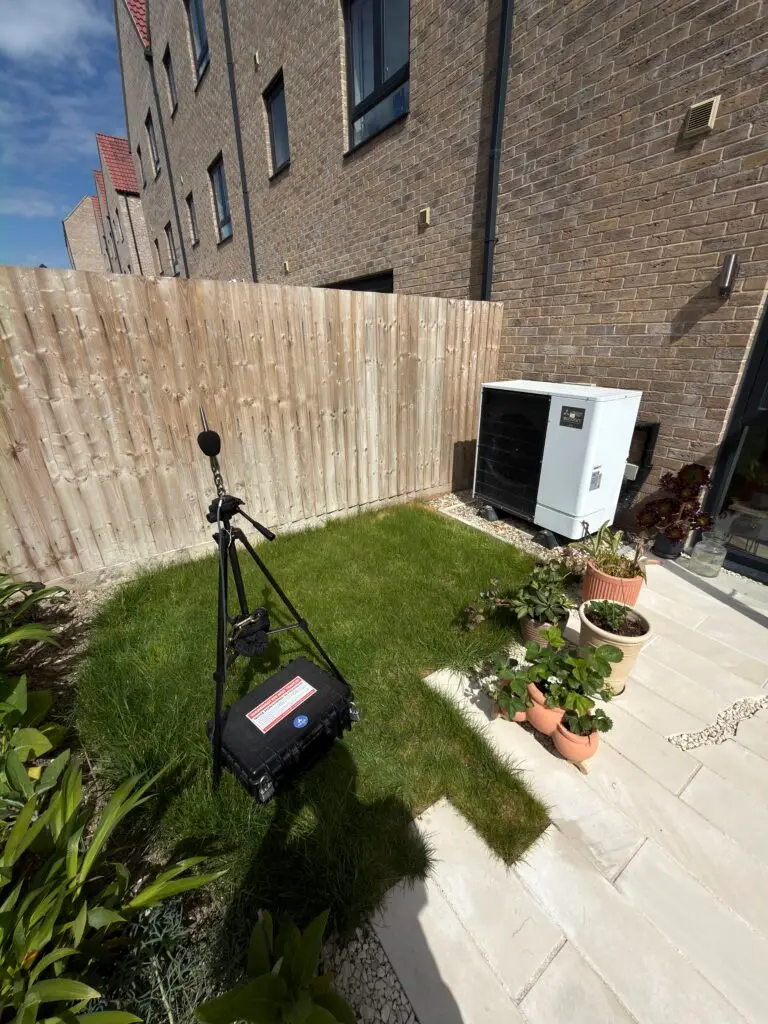
Granted · Greater Cambridge Shared Planning · Jul 2026
Householder application 26/01947/HFUL. See our case studies →

Related plant work · Milton Keynes City Council · Dec 2025
Low BS 4142 impact, no mitigation needed. Read the case study →
★★★★★
“Two quite different jobs, and he handled both superbly… Council liaison and any amendments the planners might ask for were included in the fixed fee… Flexible, thorough, patient, and genuinely invested in getting us the right outcome rather than just producing a document.”
Tom Bradshaw · BS 4142 heat pump assessments, Hackney and Islington
Frequently asked questions
Straight answers to the questions homeowners, installers and developers ask about heat pump noise assessments.
Often not, if the installation qualifies as permitted development, which in England includes meeting MCS 020(a). If it doesn’t qualify, for example because of the unit’s position, the property’s listed status or local restrictions, planning permission may be needed and the council may ask for a noise assessment to BS 4142. Our guide to reducing air source heat pump noise covers the practical options.
MCS 020(a) is a calculation method, not a product test. It uses the manufacturer’s declared sound data to predict the level at the assessment position, 1 m from the centre of any door or window to a habitable room of a neighbouring property. The limit is 37 dB(A). MCS 020(a) has been the named standard for permitted development in England since 29 May 2025.
Since 29 May 2025, permitted development in England allows up to two units on a detached house, the 1 m boundary condition is omitted, the volume limit is 1.5 m³ for a dwellinghouse and MCS 020(a) is the named standard. Other conditions still apply.
No. Scotland, Wales and Northern Ireland stay on MCS 020 and their own rules, so the position needs checking for each nation.
Yes. Permitted development status is not a defence to statutory nuisance. Meeting MCS 020(a) reduces the risk, but it does not prevent a complaint or investigation. Councils usually assess complaints using BS 4142, and a statutory nuisance leads to an abatement notice under section 80 of the Environmental Protection Act 1990.
It compares the rating level, which is the specific sound level plus any corrections for acoustic character, with the background sound level. A rating level around 10 dB above background is likely to be a significant adverse impact, around 5 dB above is likely to be an adverse impact, and at or below background is a low impact, all depending on context.
Simple noise assessments can start from around £750, and a planning noise survey and report for a small-to-medium project commonly costs £1,000–£2,500+. The fee depends on how long monitoring needs to run, the number of measurement positions and what the council requires. We always provide a fixed-fee quote. Our guide to noise assessment costs explains the main price factors.
For a BS 4142 assessment, usually yes. The background sound level has to be measured at or representative of the nearest homes, ideally over the hours the unit will run. Predictions then use the manufacturer’s noise data for the unit you plan to install.
Yes. We can measure the unit as it operates, identify any tonal or low-frequency content, and recommend practical changes, from maintenance and time controls to screening or replacement.
Heat pump noise assessments
Send us the site address, drawings, the heat pump model and any comments from the council or Environmental Health. We’ll confirm exactly which assessment you need and send a fixed-fee quote. Speak directly to Mathew Vaughan MSc MIOA, the consultant who does the work.
MIOA acoustic consultant · Class 1 instrumentation · Fixed fees · UK-wide