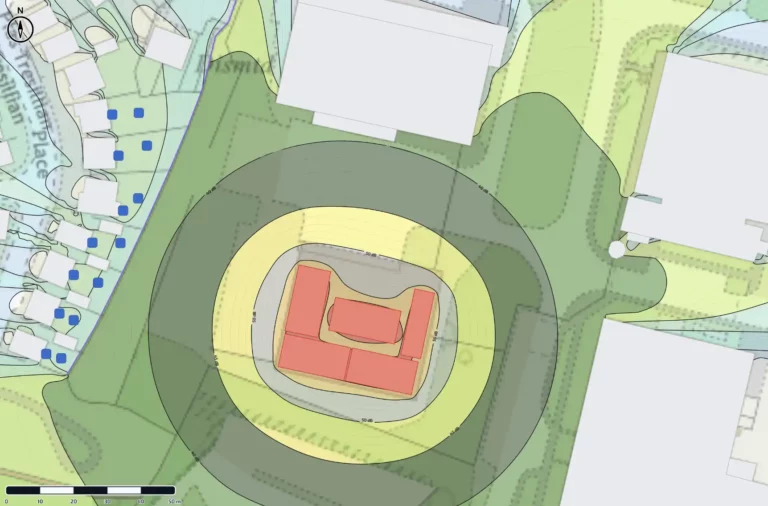

Many planning permissions arrive with a noise condition attached. The council is satisfied the scheme can work, but it wants the detail before work starts, before anyone moves in, or for as long as the use continues. Getting that detail right first time saves weeks, and on a pre-commencement condition it can be the difference between starting on site and waiting.
This guide covers the conditions we see most often, what a submission needs to contain, and how they played out on our own recent cases. The council references are included so you can check each one on the planning register.
The noise conditions councils use most
A scheme of sound insulation before work starts
The most common residential condition asks for a scheme showing that internal and garden noise levels will meet set targets, approved before development begins. The targets are usually based on BS 8233 and ProPG, and the council often writes them into the condition.
On a new house in Moston, Manchester, the condition set 35 dB LAeq in living rooms by day, 30 dB LAeq in bedrooms at night with no more than 15 events above 45 dB LAmax, and 55 dB LAeq in the garden. It also required the survey to capture rush-hour and night-time traffic.
Limits on plant noise
Air conditioning, extract and refrigeration plant is often approved subject to a limit at the nearest homes, usually a BS 4142 rating level that must not exceed the background level, or must sit a set margin below it. Some conditions ask for the final unit to be confirmed before it is installed, so the limit can be checked against the actual model rather than the one assumed at planning stage.
Controls on how a use operates
Leisure and hospitality uses tend to get operational conditions. For a five-court padel centre in Rogerstone, Environmental Protection raised no objection subject to conditions on hours, sound insulation and openings. For a racket sports centre in Dundee, Environmental Health supported the application subject to conditions. These conditions are about how the building is run, so they need to be practical for the operator, not just acoustically sound.
Testing before occupation
Some conditions have a second part requiring testing once the building is complete, to show the scheme was built as approved. In Moston, part (a) covered the design and part (b) requires verification testing before the house is occupied. Build the testing into the programme from the start.
Compliance with the approved report
Sometimes the noise assessment itself becomes the obligation. For a kitchen extract in Barrow-in-Furness, the council granted permission with the noise assessment listed among the approved documents. The measures in the report then have to be delivered, so its recommendations need to be ones the client can actually commit to.
What a submission needs
Start with the exact wording of the condition. It tells you what has to be shown, when, and to whom. Then make sure the report:
- measures the periods the condition names, such as rush hour, night-time or the quietest hours of operation
- assesses against the targets in the condition, not a set chosen by the consultant
- sets out a specific scheme, with glazing performance, ventilation and any plant limits stated as numbers the design team can build
- deals with ventilation and overheating, so the internal targets do not rely on windows being shut on hot nights
- reports the result against every target in the condition, one by one
In England, the council should normally decide an application to discharge a condition within eight weeks, so allow for that in the programme. Starting work before a pre-commencement condition is discharged can put the permission at risk, so do not treat the wait as optional.
A worked example: Moston, Manchester
An earlier attempt to discharge the Moston condition had not succeeded because no sound insulation scheme had been provided. Our submission set one out against each of the council’s targets:
| Target in the condition | Result with standard Rw 33 dB double glazing |
|---|---|
| Living rooms, day: 35 dB LAeq | 30 dB |
| Bedrooms, night: 30 dB LAeq | 22 dB |
| Bedrooms, night: no more than 15 events above 45 dB LAmax | 11th highest event 41 dB |
| Garden: 55 dB LAeq | About 53 dB |
The survey ran for 24 hours with the microphone at first-floor height, 1 metre from the façade facing the road. The ventilation strategy kept windows openable for purge ventilation, in line with Approved Documents F and O and the AVO Guide. Manchester City Council approved the details and discharged part (a) in January 2026 (CDN/25/1090, condition 13a of 132185/FO/2021). Part (b), verification testing, follows before occupation.
None of this needed expensive glazing. It needed the scheme to be set out clearly against the condition.
Getting conditions discharged quickly, or avoiding them
The fastest discharges we see are on schemes where the planning-stage report already did most of the work. For a café and evening bar in Southampton, the report set a plant limit of 41 dB at the nearest windows, specified anti-vibration mounting, and required the final unit to be verified before installation. Permission was granted in May 2026 (F/26/101048), and the sound insulation and noise conditions were discharged the following month (DC/26/101444).
Sometimes a thorough report means no noise condition is needed at all. A residential conversion in Totton covered road traffic, commercial noise, kitchen extract plant, glazing, ventilation and overheating at planning stage. Consent was granted with no further noise comments and no noise-related conditions.
What to send us
- the decision notice, with the full wording of the condition
- the approved plans and any later amendments
- Environmental Health or Environmental Protection comments, if you have them
- any previous noise report for the site
- your target start date, so we know whether the condition is holding up work
If you are still at application stage, it is worth asking for the assessment to be scoped with likely conditions in mind. See our noise impact assessments for planning, our guide to what a noise impact assessment report includes, and typical noise assessment costs.